
What the Phase 1 worksheet covers
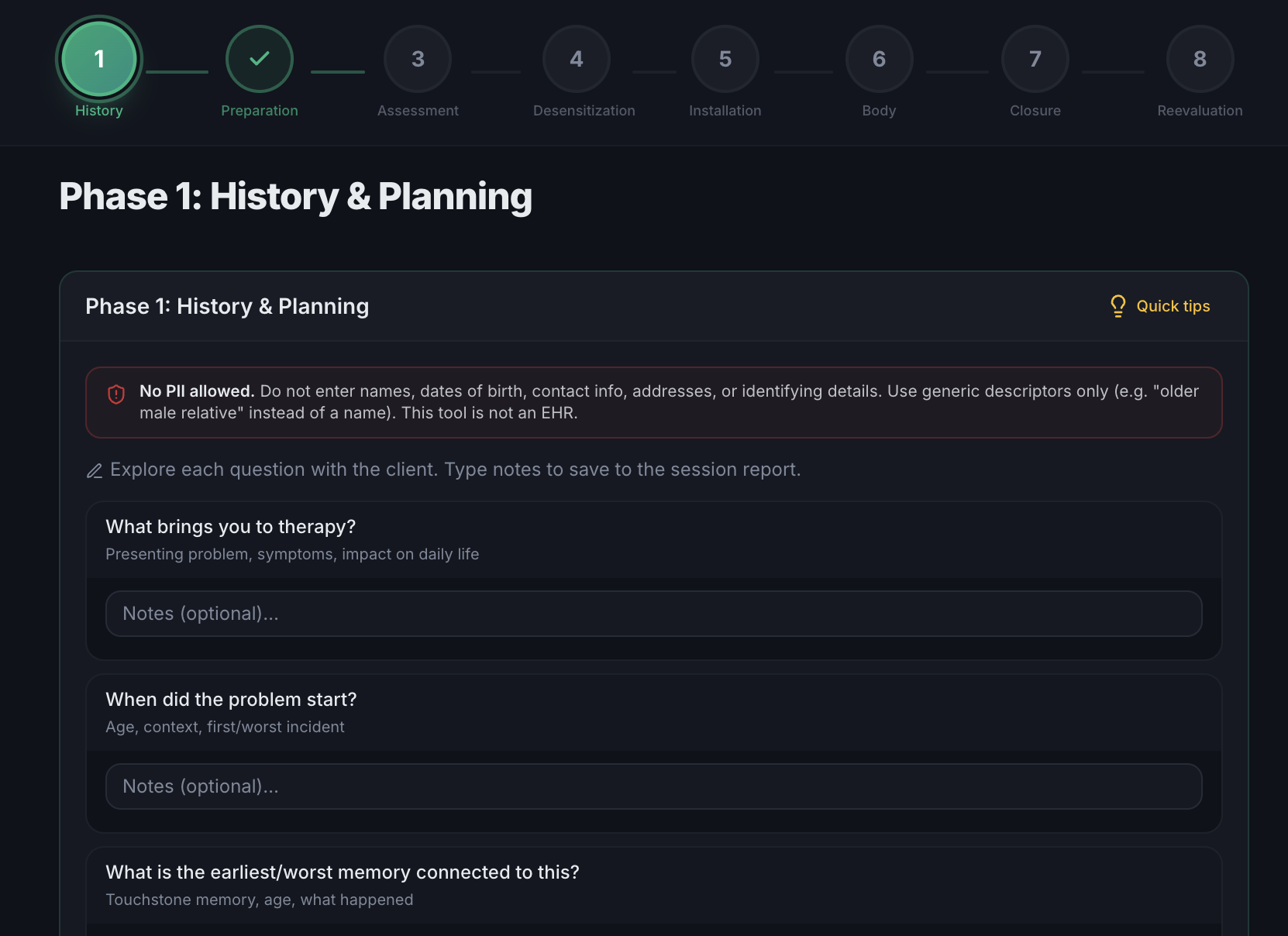
Phase 1 is history-taking and treatment planning — not intake paperwork. The worksheet is organised around what you actually need before you can build a plan:
- Presenting problem and goals — in the client's own words, with symptom onset
- Trauma and adversity history — single-incident, developmental, and ongoing stressors
- Stability and safety screen — suicidality, self-harm, substance use, current danger
- Dissociation screen — prompts to decide whether formal screening (e.g. DES-II) is indicated
- Resources and strengths — existing regulation skills, supports, prior therapy response
- Target candidates — touchstone, worst, most recent, present triggers, future template
- Readiness check — what must be in place before Phase 2 preparation is complete
How to use it in a first EMDR session
- Start with presenting problem and goals; keep the client's language verbatim — it usually contains the negative cognition.
- Take the history broadly before going deep. You are mapping the network, not reprocessing it.
- Run the stability and dissociation prompts before you write any target list. A high dissociation score changes the plan, not just the pacing.
- List target candidates as they surface. Use float-back or the affect bridge to test for a touchstone when a present trigger feels disproportionate.
- Close with the readiness check and decide explicitly whether the next session is more Phase 1, Phase 2 resourcing, or assessment.
Phase 1 commonly takes more than one session with complex presentations — that is expected, not a delay.
From worksheet to target sequence plan
The target candidate grid is designed to transfer directly into a three-pronged plan: past touchstone and related memories, present triggers, and future template. Cluster the candidates by negative cognition theme rather than by chronology — that is what drives generalisation across the memory network.
Use the Target Sequence Plan template for the next step, or build it inside the app where targets, SUD/VoC and phase progress carry through the whole course of treatment.
Reviewed by the EMDR Assist Clinical Team.
Educational reference material for EMDR-trained clinicians. It does not replace EMDRIA-approved Basic Training, consultation, supervision, or clinical judgement, and it is not medical advice.
Frequently asked questions
Is the EMDR Phase 1 worksheet free?
Yes. The Phase 1 history-taking worksheet is a free PDF for clinicians — enter your name and email and the download link is emailed to you.
How long should EMDR Phase 1 take?
One to two sessions for a single-incident presentation; often several sessions with complex trauma, dissociation, or ongoing instability. Phase 1 ends when you have a workable treatment plan, not at a fixed session count.
Does the worksheet include dissociation screening?
It includes screening prompts and guidance on when formal screening is indicated. For scoring, pair it with the DES-II color-coded clinician edition in the resource library.
Can I use this worksheet with clients directly?
It is a clinician-facing document. For client-facing psychoeducation, use the plain-language 'What is EMDR?' handout instead.
Do I need EMDR training to use it?
Yes — the worksheet supports clinicians with EMDRIA-approved basic training or an international equivalent. It is not a substitute for training or consultation.
Related tools for EMDR therapists
Try EMDR Assist with your next session
14-day free trial. No credit card. Built by clinicians, for clinicians.