

Free printable PDF
EMDR Protocol Script Pack (PDF)
The full eight-phase verbatim script set in one printable document.
The short answer
The core EMDR scripts a clinician uses are the Phase 2 resourcing scripts — Safe/Calm Place, Container, RDI, Light Stream and Four Elements — plus the Phase 3 assessment sequence (image, negative cognition, positive cognition, VOC, emotion, body location, SUD) and the Phase 7 closure script for incomplete sessions.
Each script below is verbatim, with installation instructions, troubleshooting and a printable PDF. See which phase each script belongs to.
Why scripts matter (especially early in your EMDR career)
EMDR's effectiveness depends on protocol fidelity. The standard scripts aren't filler — the exact wording of "What do you get when you think of that image and those words…?" is calibrated to elicit the body-state and emotional data that drives reprocessing. Paraphrasing in early sessions almost always means missed assessment data and slower processing.
Even ten-year EMDR clinicians keep scripts at hand for less-frequent protocols: light stream, recent traumatic event protocol, restricted processing, the constricted affect interweave script. The script isn't a crutch — it's a clinical safety net.
Reviewed by the EMDR Assist Clinical Team, EMDR-trained clinicians.
Educational reference material for EMDR-trained clinicians. It does not replace EMDRIA-approved Basic Training, consultation, supervision, or clinical judgement, and it is not medical advice.
The full EMDR script library (free PDFs)
Every script we ship as a printable PDF, grouped by protocol phase. All free, all clinician-built. Click any tile for the full page (with usage notes, contraindications, and the download).
- EMDR Script PDF — Free 8-Phase Protocol Script for CliniciansA free EMDR script PDF for clinicians: the standard 8-phase protocol on one desk reference — suggested therapist wording, procedural cues and stall-recovery prompts on a single PDF you can keep on your desk.
- EMDR Resourcing Scripts PDF — Free Phase 2 DownloadA free EMDR resourcing scripts PDF — five Phase 2 scripts on a single sheet: Calm Place, Container, and Resource Development & Installation for Nurturing, Protective and Wise figures.
- EMDR Container & Calm Place ScriptsThe two foundational EMDR Phase 2 resources, scripted step-by-step for in-session installation and for clients to use between sessions.
- Resource Development & Installation (RDI) Script — Free PDFResource Development & Installation based on Korn & Leeds (2002) — scripted Nurturing, Protective, Wise and Mastery anchors with installation BLS cues and stabilisation safeguards.
- EMDR Phase 3 Assessment WorksheetA printable Phase 3 worksheet to capture Image, NC, PC, VoC, Emotion, SUD and body location for a single target — with the standard NC/PC cluster table on the back.
- Float-back & Affect Bridge — Touchstone WorksheetA printable Phase 1 worksheet for tracing a present-day disturbance back to its earliest accessible memory — suggested therapist scripts for both the float-back (Browning, 1999) and the affect bridge (Watkins, 1971) on one PDF.
- EMDR Cognition Clusters Handout — Eliciting the NC in Phase 3The standard EMDR negative and positive cognition clusters on a single clinician handout — example beliefs, matched PCs, elicitation prompts, and the most common Phase 3 pitfalls.
- Cognitive Interweaves EMDR PDF — Free Cheat Sheet DownloadFree cognitive interweaves EMDR PDF — a clinician quick-reference for unblocking stalled Phase 4 processing, with example interweaves across responsibility, safety, choice, education, imagination and somatic prompts.
- EMDR Session Processing LogA live clinician log for Phase 4–6 reprocessing — record each BLS set, what came up, the SUD trajectory, interweaves used, Installation, Body Scan and closure.
- EMDR Phase 6 Body Scan & Somatic Tracking WorksheetA printable Phase 6 companion sheet — somatic map, BLS-set tracking, residual-sensation interweaves, and end-of-session closure check on a single sheet per completed target.
- Acute Traumatic Incident Worksheet (A-TIP) — Free EMDR PDFA printable worksheet for a brief, contained EMDR intervention after a recent critical incident — readiness check, BLS-set tracking, positive belief and closure on one document.
- EMDR Target Sequence Plan TemplateA printable three-pronged Target Sequence Plan worksheet — organise past targets, present triggers and future templates before reprocessing begins.
- EMDR Phase 1 History-Taking WorksheetA clinician-built printable for the first 1–3 EMDR sessions — intake, readiness screening, and the three-pronged target sequence plan on a single worksheet.
- DES-II Scoring Guide & Color-Coded Clinician EditionThe 28-item Dissociative Experiences Scale (Carlson & Putnam, 1993) reformatted for the clinician's eye — color-coded subscales, DES-T taxon items flagged, and a one-page scoring + EMDR decision guide.
- EMDR Treatment Plan TemplateAn editable phase-by-phase EMDR treatment plan template — goals, target sequence, outcome measures, risk factors, and medical-necessity language on one printable document.
- EMDR Informed Consent TemplateA printable, state-adaptable informed consent template for clinicians beginning EMDR with a new client — risks, benefits, alternatives, confidentiality limits, and signature blocks on a single PDF you can adapt and use.
- EMDR Case Conceptualisation WorksheetA one-page EMDR case conceptualisation worksheet to organise what you know about a client — AIP formulation, NC cluster, three-pronged map, risk factors and readiness — before you build the Target Sequence Plan.
- EMDR Outcome Measures TrackerA single printable sheet for tracking the four standard EMDR outcome measures — PCL-5, PHQ-9, GAD-7, and DES-II — across a full course of treatment, with interpretation bands and a per-session SUD column.
- EMDR Consultation Hours Log TemplateA printable consultation-hours log for clinicians working toward EMDRIA Basic Training completion or EMDRIA Certification — date, consultant, format, hours, topics, and consultant attestation.
- EMDR Progress Note TemplateAn EMDR progress note template — structured around the 8-phase model with medical-necessity language, measures, risk screening and plan.
- EMDR for Kids — Free Clinician Toolkit (PDF)A clinician toolkit for adapting EMDR with children aged roughly 4–12 — child-friendly resourcing, Phase 3 wording, BLS adaptations and a parent psychoeducation page.
EMDR scripts by name
Looking for one specific EMDR script? Each of these has its own page with the verbatim wording, clinical notes, and a free printable PDF:
- Safe / Calm Place EMDR script — Shapiro's Phase 2 Safe/Calm Place induction, verbatim, with a kids adaptation.
- Container EMDR script — Container exercise script for closing incomplete sessions and between-session disturbance.
- RDI (Resource Development & Installation) script — Korn & Leeds mastery, relational and symbolic resource installation script, verbatim.
- Light stream EMDR script — Body-based light stream closure script for residual somatic disturbance.
- Four Elements exercise script — Earth, air, water, fire — the one-minute stress reduction sequence for Phase 2 and homework.
- EMDR closure script (complete & incomplete) — Phase 7 close-down wording for both complete sessions and incomplete targets.
- Phase 3 assessment script — NC/PC, VOC, emotion, SUD and body-location prompts in Shapiro's order.
- Float-back & affect bridge script — History-taking bridge from present disturbance to the earliest touchstone memory.
- Cognitive interweave scripts — Responsibility, safety and choice interweaves for blocked processing.
- Future template script — Third-prong script for rehearsing an anticipated trigger with the positive cognition, plus when to run it.
- EMDR resourcing scripts collection (PDF) — Phase 2 resourcing scripts gathered into one printable PDF.
- EMDR 8-phase protocol script (PDF) — The full standard protocol script as a printable PDF.
Phase 2: Resourcing scripts (free)
The core preparation scripts every EMDR clinician needs:
- Safe/Calm Place — Shapiro's full induction with cue word and BLS to strengthen
- Resource Development & Installation (RDI) — Korn & Leeds protocol for mastery, relational, and symbolic resources
- Container — for closing incomplete sessions and managing between-session disturbance
- Light Stream — body-based affect-regulation for somatic activation
- Protective Figures — for complex trauma and attachment work
EMDR Assist includes free AI-generated phase 2 scripts tailored to each client's presentation, plus the standard verbatim versions.
Phase 3 assessment script
The phase 3 sequence Francine Shapiro standardized:
- "What picture represents the worst part of the incident?"
- "What words go with that picture that express your negative belief about yourself now?" (NC)
- "When you bring up that picture and those words, what would you like to believe about yourself now?" (PC)
- "When you think of the incident, how true do those words [PC] feel to you now on a scale of 1 to 7?" (VOC)
- "When you bring up that picture and those words [NC], what emotions do you feel now?"
- "On a scale of 0 to 10, where 0 is no disturbance or neutral and 10 is the highest disturbance you can imagine, how disturbing does it feel now?" (SUD)
- "Where do you feel it in your body?"
Skipping any of these costs reprocessing time. The full assessment is logged automatically by EMDR Assist's session notes module.
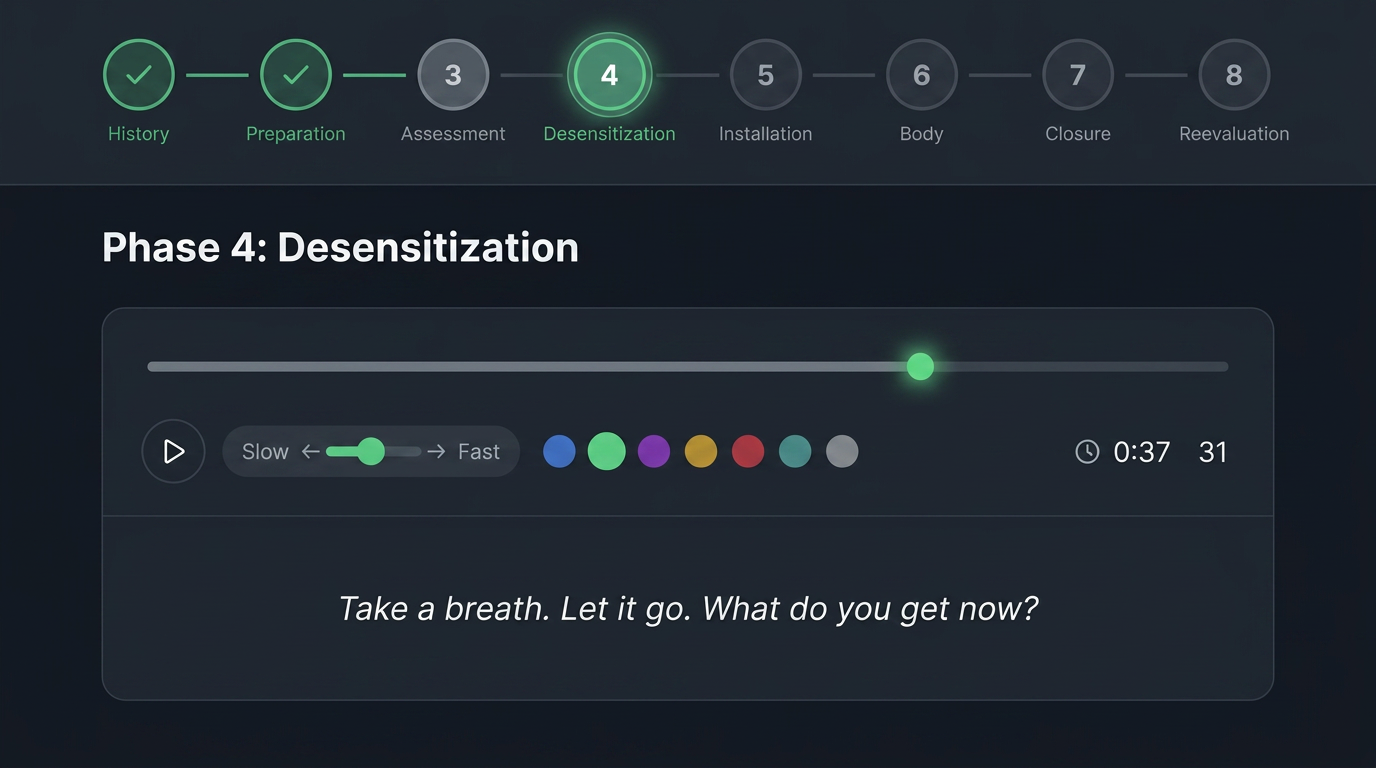
Phase 4 desensitization scripts
The standard set sequence:
- Set: "I'd like you to bring up that picture, those negative words [NC], notice where you're feeling it in your body — and follow my fingers."
- Between sets: "Take a breath. Let it go. What do you get now?" / "What are you noticing?"
- Return to target: "When you bring up that original incident, what do you get now?" / "On a scale of 0 to 10, how disturbing does it feel now?"
- Cognitive interweaves: when processing stalls — responsibility, safety, choice, time orientation, perspective-taking
See our cognitive interweaves cheat sheet for the full menu.
Closure scripts
For completed sessions (SUD 0, VOC 7, clear body scan): brief affirmation, log activities, schedule next session.
For incomplete sessions: the full Shapiro closure protocol — acknowledging the work, reminding the client that processing continues between sessions, container exercise, calm place reactivation, log instruction, and emergency contact reminder.
EMDR Assist auto-detects incomplete sessions (ending SUD > 0) and surfaces the right closure script at session end.
References
- Shapiro, F. (2018). Eye Movement Desensitization and Reprocessing (EMDR) Therapy: Basic Principles, Protocols, and Procedures (3rd ed.). Guilford Press.
- Korn, D. L., & Leeds, A. M. (2002). Preliminary evidence of efficacy for EMDR resource development and installation. Journal of Clinical Psychology, 58(12), 1465–1487.
- EMDR International Association (EMDRIA). About EMDR Therapy. Accessed 2026.
Frequently asked questions
Are these EMDR scripts EMDRIA-approved?
These scripts follow Francine Shapiro's standard protocol as taught in EMDRIA-approved basic training. They're not separately credentialed by EMDRIA, but the wording matches the standard.
Can I use these EMDR scripts without basic training?
No. EMDR is a clinical intervention that requires EMDRIA-approved basic training. Scripts are reference material for trained clinicians — they are not a substitute for training.
Where can I download EMDR scripts as a PDF?
Our /resources page includes free PDF downloads of the most common phase 2 and phase 3 scripts, plus a printable cognitive interweaves cheat sheet.
What's the best EMDR script for safe place / calm place?
Shapiro's original Safe/Calm Place induction is the standard reference version. EMDR Assist includes the verbatim script plus an AI-generated variant tailored to each client's preferences and triggers.
Is there a free EMDR script PDF I can print?
Yes — every script on this page ships as a free printable PDF. The most-downloaded are the Safe/Calm Place script, the container script, and the full 8-phase protocol script.
What is the EMDR container script?
The container exercise asks the client to imagine a sealed container strong enough to hold anything unprocessed until the next session. It is used at closure, especially when a session ends with SUD above 0. The full verbatim wording is on our container script page.
What is the EMDR light stream script?
Light stream is a Phase 2 affect-regulation script: the client identifies the shape, colour and temperature of a body sensation, then imagines a healing light entering and dissolving it. It is often used when a client is somatically activated after an incomplete set.
Do I need scripts for every session?
Most experienced EMDR clinicians have phases 3, 4, and 7 internalized but still reference scripts for phase 2 resourcing (especially RDI and light stream) and for closure on incomplete sessions.
Related tools for EMDR therapists
Verbatim Phase 2 induction, adult and kids.
Resource Development & Installation, verbatim.
Closure de-arousal for body residue.
Complete and incomplete session close-downs.
Portable one-minute regulation skill.
Cheat sheet for blocked processing.
Try EMDR Assist with your next session
14-day free trial. No credit card. Built by clinicians, for clinicians.