

Why SUD and VOC tracking matters in EMDR
The Subjective Units of Distress (SUD) and Validity of Cognition (VOC)scales are the two most important measurement tools in EMDR therapy. SUD tracks how disturbing a memory feels right now (0 = neutral, 10 = worst imaginable). VOC tracks how true a positive cognition feels (1 = completely false, 7 = completely true). Together they tell you, in real time, whether processing is moving, stalled, or complete.
Most EMDR therapists track these scores on paper — which means scribbling between sets, missed data points, illegible handwriting, and tedious post-session retyping into the chart note. EMDR Assist's SUD/VOC tracker turns logging into a single tap and gives you a live visual trajectory of the session as it unfolds.
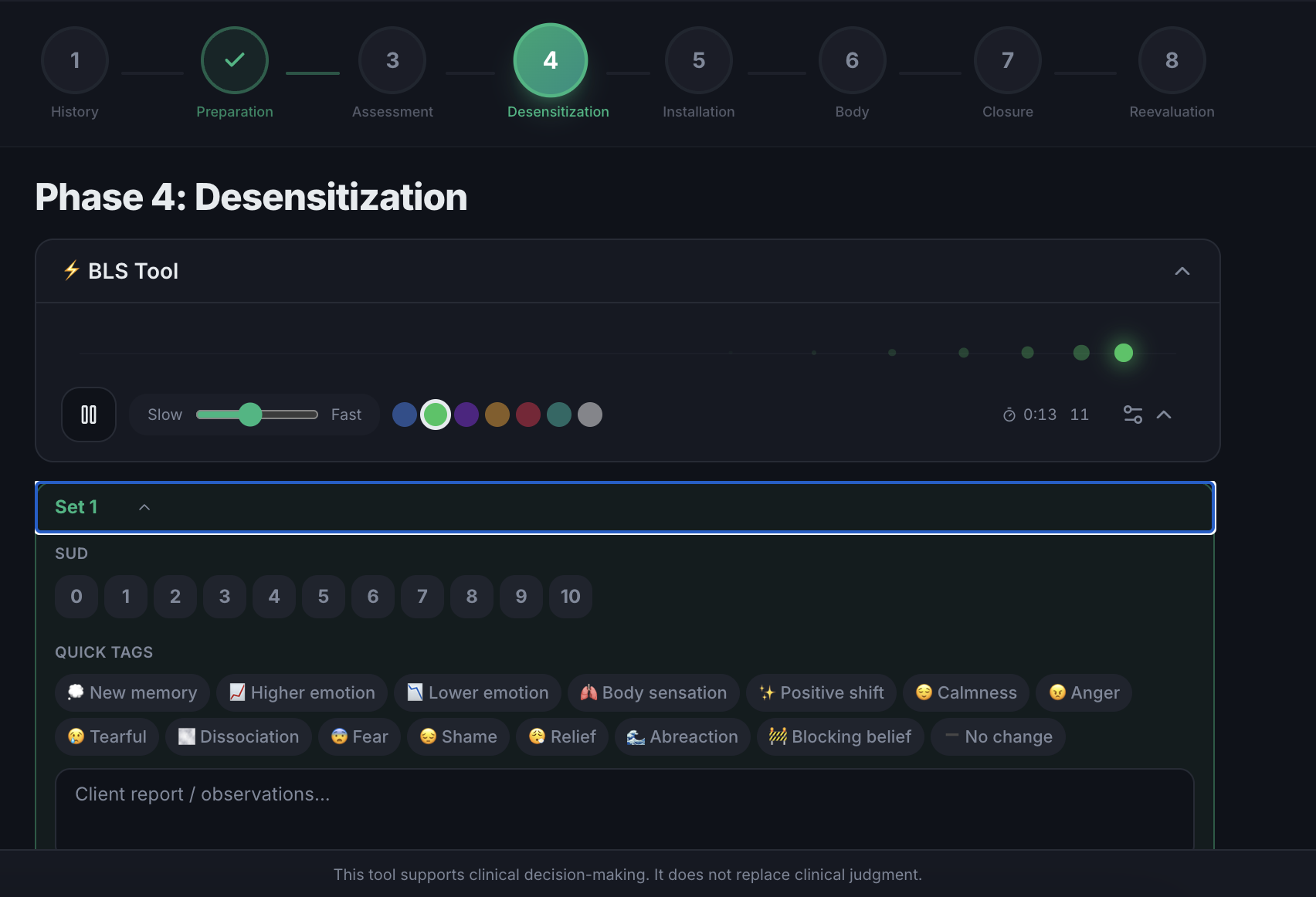
Live SUD tracking during desensitization
Phase 4 (Desensitization) is where SUD logging matters most. Between every set of bilateral stimulation, EMDR Assist prompts you to capture a SUD with a quick 0–10 selector. The score is instantly added to a visual timeline that shows you the trajectory across the session — flat lines, steady descent, sudden spikes, or plateaus.
That visual feedback is clinically powerful: it surfaces stuck points the moment they appear, shows you when an interweave actually moved the system, and gives you objective data to share with the client at the end of the session ("You started this memory at an 8 and ended at a 2 — that's real change").
VOC capture during installation
When you transition from desensitization to installation, EMDR Assist automatically prompts for the initial VOC of the positive cognition you set during assessment. After each set of installation BLS, you're prompted again until you reach VOC 7 (or the highest the client can ecologically endorse).
Both the initial VOC and the final VOC are captured in the structured session report — important data for treatment planning, supervision, and any insurance documentation that requires measurable progress.
From scores to a defensible session report
At the end of every session, the SUD timeline, VOC scores, target image, NC/PC, body location, interweaves used, and closure technique are automatically composed into a PDF session report. No retyping. No missed fields. The report is structured the way EMDR consultants and EMDRIA reviewers expect to see clinical EMDR documentation.
For therapists in EMDRIA consultation, the SUD/VOC trajectory is invaluable — it lets your consultant see exactly how processing moved across the session without you having to reconstruct it from memory days later.
Tracking scores across sessions, not just within them
EMDR is a multi-session therapy. The same target may be revisited across two, three, or more sessions before SUD reaches zero and VOC reaches 7. EMDR Assist preserves SUD and VOC scores across sessions so during Phase 8 Reevaluation you can see the full trajectory of a target — from its initial SUD baseline through every desensitization session to closure.
This cross-session view also makes treatment planning more concrete. You can see at a glance which targets in your target sequence plan have been fully processed, which are mid-processing, and which still need to be addressed.
Designed to fit how EMDR sessions actually flow
The SUD/VOC tracker isn't a separate app or a popup — it's woven into the same workspace as the BLS controls and the phase tracker. When you stop a set of BLS, the SUD prompt appears in the same place your eye already is. When you advance to installation, the VOC prompt appears automatically. No menus, no context switching, no breaking attention with the client in front of you.
This kind of seamless integration is the difference between a tool that gets used in real sessions and a tool that gets abandoned by week two.
Frequently asked questions
What are SUD and VOC scales?
SUD (Subjective Units of Distress) is a 0–10 scale measuring how disturbing a memory feels in the moment. VOC (Validity of Cognition) is a 1–7 scale measuring how true a positive cognition feels. Both are core EMDR measurement tools developed by Francine Shapiro.
Does the tool prompt me to log scores, or do I have to remember?
It prompts you. Between every set of BLS during desensitization, you'll see a SUD prompt. When you transition to installation, you'll see VOC prompts. You can also log scores manually at any point.
Can I see SUD changes across multiple sessions for the same target?
Yes. SUD and VOC scores are preserved across sessions so during Phase 8 Reevaluation you can see the full trajectory of a target from baseline through every processing session.
Are the scores included in the session report?
Yes — the SUD timeline, VOC scores, and all related session data are automatically composed into a PDF session report at the end of every session.
Can I export SUD/VOC data for research or supervision?
Yes. Session reports include the full SUD trajectory and can be shared with EMDRIA-approved consultants. The data is structured the way clinical reviewers expect to see EMDR documentation.
Related tools for EMDR therapists
Try EMDR Assist with your next session
14-day free trial. No credit card. Built by clinicians, for clinicians.