

Free printable PDF
Complete Resourcing Scripts (PDF)
Every Phase 2 resourcing protocol in one printable pack — Calm Place, Container, RDI figures, Light Stream and Four Elements.
The short answer
Resourcing in EMDR means installing internal stabilization resources during Phase 2 — Safe/Calm Place, Container, Resource Development and Installation (RDI), Light Stream and Protective Figures — so the client can tolerate the affect that reprocessing will raise.
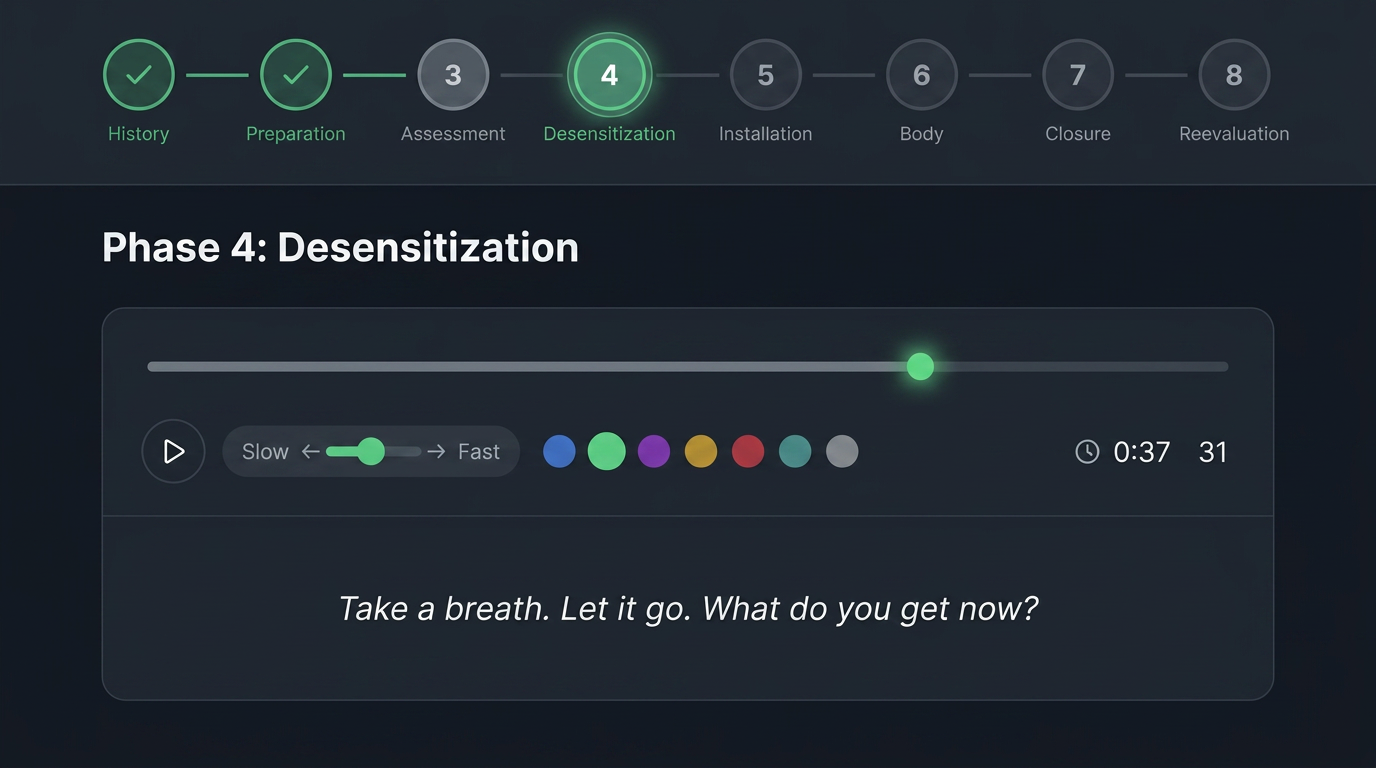
Each resource is installed with short, slow BLS sets (4–8 alternations) and a cue word, never with the long fast sets used in Phase 4. Choose by presentation: Calm Place for general affect tolerance, Container for between-session containment, RDI for complex trauma and low ego strength, Light Stream for somatic residue. The verbatim scripts and a decision tree follow, and the free resourcing scripts PDF collects all of them.
Watch: Calm place and container (2:49)
What 'resourcing' actually means in EMDR
In EMDR, resourcing is the Phase 2 work of building or strengthening internal capacities — affect tolerance, self-soothing, dual attention — before any reprocessing begins. It's not relaxation. It's clinical preparation: the client needs reliable access to a regulated state they can return to when processing destabilizes them, plus the resources to close an incomplete session safely.
For straightforward single-incident trauma, Phase 2 is often one session: Safe/Calm Place plus Container. For C-PTSD, dissociative presentations, or attachment trauma, resourcing can take 4–12 sessions and draws heavily on RDI and ego-state work. See our Complex Trauma & EMDR ultimate guide for the full extended preparation framework.
Reviewed by the EMDR Assist Clinical Team, EMDR-trained clinicians.
Educational reference material for EMDR-trained clinicians. It does not replace EMDRIA-approved Basic Training, consultation, supervision, or clinical judgement, and it is not medical advice.
Every resourcing script we ship (free PDFs)
Print any of these for in-session use, or hand the client-facing versions between sessions. All EMDRIA-aligned and reviewed by EMDR-trained clinicians.
- EMDR Resourcing Scripts PDF — Free Phase 2 DownloadA free EMDR resourcing scripts PDF — five Phase 2 scripts on a single sheet: Calm Place, Container, and Resource Development & Installation for Nurturing, Protective and Wise figures.
- EMDR Container & Calm Place ScriptsThe two foundational EMDR Phase 2 resources, scripted step-by-step for in-session installation and for clients to use between sessions.
- Resource Development & Installation (RDI) Script — Free PDFResource Development & Installation based on Korn & Leeds (2002) — scripted Nurturing, Protective, Wise and Mastery anchors with installation BLS cues and stabilisation safeguards.
- Grounding Techniques for Clients — Free Handout PDFFour evidence-based grounding practices clients can use between sessions when they're overwhelmed — written in plain language, scripted step-by-step.
- Window of Tolerance WorksheetA client-friendly handout based on Dan Siegel's Window of Tolerance model — recognise hyper- and hypoarousal, and bring yourself back into the window.
- The Lighthouse & the Storm — Window of Tolerance for AdultsA 4-page illustrated adult companion to the Window of Tolerance — a hand-painted watercolour lighthouse, a nervous-system metaphor, and three anchors clients can use when the water rises.
- The Filing Cabinet Brain — How EMDR Reprocesses MemoryA 4-page illustrated adult handout that explains Shapiro's Adaptive Information Processing model as a wooden filing cabinet — why some memories won't stay in the drawer, and what EMDR actually does.
- The Two Trains — How Dual Attention Works in EMDRA 4-page illustrated adult client handout — dual attention in EMDR reprocessing as two trains on parallel tracks. Present train, past train, and what to do if either fades.
- The River & the Rocks — When EMDR Processing StallsA 4-page illustrated adult client handout on blocking beliefs and looping content in EMDR — why the river gets stuck, how cognitive interweaves help, and what to notice between sessions.
- Tolly the Turtle — Window of Tolerance for KidsAn illustrated 8-page companion to the Window of Tolerance for pediatric clients — designed to be printed by EMDR therapists and worked through with a child in session.
- Between-Session Log — Free Client Worksheet (PDF)A simple one-page worksheet for clients to capture feelings, body sensations, dreams, triggers and SUDs between sessions — then bring it to next week.
- DES-II Scoring Guide & Color-Coded Clinician EditionThe 28-item Dissociative Experiences Scale (Carlson & Putnam, 1993) reformatted for the clinician's eye — color-coded subscales, DES-T taxon items flagged, and a one-page scoring + EMDR decision guide.
Which resource for which client (decision tree)
- Single-incident, well-regulated adult → Safe/Calm Place + Container. Move to Phase 3 next session.
- Somatic activation, freeze, body-stored trauma → Light Stream. Body-based, bypasses cognitive resistance.
- Negative self-concept, attachment trauma, C-PTSD → RDI (Korn & Leeds): mastery + relational + symbolic resources, paired with slow short BLS.
- Client can't generate a safe place (common in early trauma) → Protective Figures or Wise Adult Self before attempting Calm Place.
- Dissociative parts → Conference Room / Meeting Place metaphor + resource installation to each part before processing.
Our in-session AI phase 2 toolkit recommends a resource based on the client's intake data and lets you load the script with one click.
Free verbatim resourcing scripts
- Complete Resourcing Scripts PDF — all five core protocols, print-ready
- RDI Script (Korn & Leeds) — full protocol with mastery, relational, and symbolic resources
- Container + Calm Place Combo — the two scripts you'll use most
- Calm Place: clinical walkthrough — when to use, when to skip
- Container exercise guide — closing incomplete sessions and between-session management
Verbatim mini-scripts for the three hardest cases
When the standard Calm Place stalls, these are the three substitutions used most often in EMDRIA-approved basic training. Read them as written, then adapt the imagery to the client's own words.
- Protective Figure (no felt sense of safety). "Bring to mind someone or something whose whole job would be to keep you safe — a person you know, someone from a book or film, an animal, a presence. You don't have to have met them. What are they like? Where would they stand in relation to you? What would they say if they knew what you've been carrying?" Add 4–8 slow bilateral passes while the client holds the image and the words. Check: "What do you notice now?" Repeat only while it strengthens.
- Mastery resource (negative self-concept, C-PTSD). "Think of a time — any time, however small — when you handled something you didn't think you could. Not a triumph, just a moment you got through. Where are you? What are you doing? What do you notice in your body as you remember it? What does that say about you?" Anchor the positive word, then 4–8 slow passes. Korn & Leeds (2002) recommend three separate mastery memories before moving on.
- Wise Adult Self (young or self-blaming parts). "Picture yourself at your most steady — the version of you who knows how this turns out. Let that self look at the younger you in that memory. What do they see? What do they want the younger one to know?" Install with short slow sets. Stop immediately if the client shifts into the younger state rather than observing it.
All three are written out in full with BLS cues in the RDI script PDF.
How to know Phase 2 is actually complete
Phase 2 ends on a functional standard, not a session count. Before moving to Phase 3, the client should be able to do all six of these — in the room, with you watching:
- Access the Calm Place (or substitute resource) within about a minute, without coaching.
- Place a real between-session disturbance into the Container and close it.
- Come back out of a mild activation using a grounding skill they chose themselves.
- Report a body-based signal for "too much" — the early cue that precedes flooding.
- Name the plan for the 24 hours after a session, including who they call.
- Tolerate a short, slow BLS set without dissociating, spacing out, or losing dual attention.
If any of the six fails, that is your next Phase 2 target — not a reason to push into reprocessing. Screen with the DES-II and, where dissociation is present, extend preparation with the CIPOS & Back-of-the-Head Scale toolkit.
Training required: these protocols are for clinicians who have completed EMDRIA-approved basic training and are working within their scope and consultation structure.
Common Phase 2 mistakes (and how to avoid them)
- Skipping resourcing because the client 'seems fine.' Stability under social conditions ≠ affect tolerance under reprocessing. Always install at least Calm Place + Container.
- Using long BLS sets during resourcing. Resource installation uses short, slow sets (4–8 saccades). Long sets can trigger associative networks and contaminate the resource.
- Forcing the standard Safe Place script on clients who can't access safety. For survivors with no felt sense of safety, jump to Protective Figures or Wise Self first.
- Not testing the resource under mild stress before Phase 3. Have the client bring up a low-SUD trigger and re-access the resource. If they can't, do more Phase 2.
For deeper troubleshooting, see our Phase 2 Ultimate Guide and the clinician's primer on resourcing.
Bring resourcing into the session itself
EMDR Assist's in-session toolkit surfaces the right resourcing script at the right moment — opening Phase 2, closing an incomplete session, or rescuing a destabilized client mid-Phase 4. The AI variants generate language matched to your client's intake (preferred imagery, cultural context, somatic anchors) while keeping the underlying protocol intact.
Try the in-session toolkit free — built and tested by practicing EMDR therapists.
References
- Shapiro, F. (2018). Eye Movement Desensitization and Reprocessing (EMDR) Therapy: Basic Principles, Protocols, and Procedures (3rd ed.). Guilford Press.
- Korn, D. L., & Leeds, A. M. (2002). Preliminary evidence of efficacy for EMDR resource development and installation in the stabilization phase of treatment of complex posttraumatic stress disorder. Journal of Clinical Psychology, 58(12), 1465–1487.
- EMDR International Association (EMDRIA). About EMDR Therapy. Accessed 2026.
Frequently asked questions
What is resourcing in EMDR?
Resourcing is the Phase 2 work of building or strengthening a client's internal capacities — affect tolerance, self-soothing and dual attention — before any reprocessing begins. It is clinical preparation, not relaxation: the client needs reliable access to a regulated state they can return to if Phase 4 destabilises them, plus what is needed to close an incomplete session safely.
Is there a free EMDR resourcing scripts PDF?
Yes. The Resourcing Scripts PDF on this site is free and contains five EMDRIA-aligned Phase 2 scripts — Calm Place, Container, and Nurturing, Protective and Wise Figure RDI scripts — with BLS cues and installation rehearsals. No signup required.
How many sessions of Phase 2 resourcing do I need before starting reprocessing?
For single-incident trauma in a regulated adult: often one session (Calm Place + Container). For C-PTSD, dissociation, or attachment trauma: 4–12 sessions is normal, sometimes more. The standard is functional, not numeric — the client must be able to access a regulated state and tolerate mild affect before Phase 3.
What's the difference between Safe Place, Calm Place, and RDI?
Safe/Calm Place is a single resource (a peaceful image) installed with short BLS. RDI (Resource Development & Installation, Korn & Leeds 2002) is a more elaborate protocol that installs three resource categories — mastery, relational, and symbolic — and is designed for complex presentations where one calm image isn't enough.
Can I use Container before Calm Place is installed?
Yes. Many clinicians install Container in the first session because it's needed immediately for between-session containment, even before Calm Place is fully developed. The two work together: Calm Place is what the client returns to, Container is where disturbance goes.
What if my client can't generate a Safe Place?
Common with early trauma. Don't push. Switch to Protective Figures, Wise Adult Self, or nurturing/protective resource development from the RDI protocol. Once the client has a felt sense of internal support, Calm Place often becomes accessible.
How do I know when Phase 2 resourcing is finished?
Use a functional test, not a session count. The client should be able to access their resource unprompted within about a minute, contain a real disturbance, come back down from mild activation using their own skill, name a body cue for 'too much', state a 24-hour post-session plan, and tolerate a short slow BLS set without losing dual attention. Any failure on that list is your next Phase 2 target.
What BLS speed and set length should I use for resource installation?
Short and slow — typically 4 to 8 passes per set, and only repeated while the resource is strengthening. Fast or long sets belong in Phase 4 reprocessing; used during installation they can open associative channels and contaminate the resource with the very material you are preparing the client to face.
Is this resourcing material EMDRIA-approved?
These are the standard protocols taught in EMDRIA-approved basic training (Shapiro Safe Place; Korn & Leeds RDI). The materials themselves are not separately credentialed by EMDRIA, but the protocols match the standard curriculum.
Related tools for EMDR therapists
Try EMDR Assist with your next session
14-day free trial. No credit card. Built by clinicians, for clinicians.