

The short answer
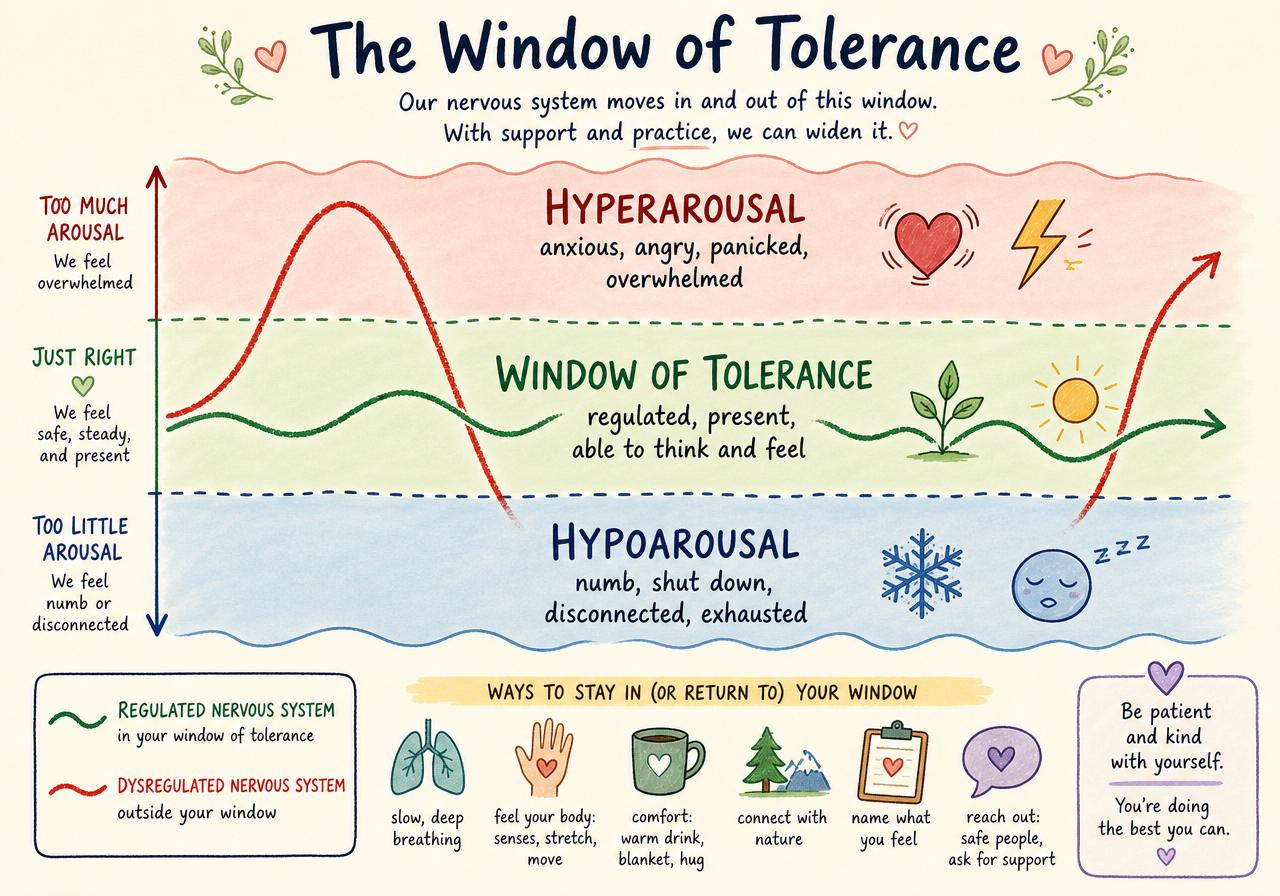
The window of tolerance, a term coined by Dr. Dan Siegel, is the range of arousal in which a person can think clearly and feel emotions without being overwhelmed. Above it is hyperarousal (panic, anger, racing thoughts); below it is hypoarousal (numbness, shutdown, feeling far away). Grounding, slow breathing, movement and therapy such as EMDR can help widen the window over time.
What is the Window of Tolerance?
The Window of Tolerance is a term coined by Dr. Dan Siegel to describe the zone of nervous-system arousal where we can think clearly, feel our emotions without being overwhelmed by them, and stay connected to ourselves and other people. Inside the window we are regulated: alert but calm, curious but grounded, able to feel a hard emotion and still be here.
Everyone's window is a different size — and it changes hour to hour depending on sleep, food, stress, hormones, and what happened five minutes ago. Trauma, chronic stress, and unmet developmental needs narrow the window; safety, co-regulation, sleep, movement, and gentle nervous-system practice widen it back out over time.
Reviewed by the EMDR Assist Clinical Team, EMDR-trained clinicians.
Educational reference material for EMDR-trained clinicians. It does not replace EMDRIA-approved Basic Training, consultation, supervision, or clinical judgement, and it is not medical advice.
What hyperarousal looks and feels like
Hyperarousal is what happens when your nervous system pushes above the top of your window. The sympathetic branch fires: adrenaline and cortisol flood the body, muscles brace, heart rate climbs, thoughts race. In everyday language it feels like anxiety, panic, anger, irritability, being on edge, being unable to sit still, or replaying something over and over.
- Racing heart, tight chest, shallow breath
- Racing thoughts, difficulty concentrating
- Irritability, snapping, rage
- Feeling unsafe when you're actually safe
- Trouble sleeping, hypervigilance
Hyperarousal is not a character flaw. It's a nervous system that learned it needed to be ready for danger. The goal isn't to turn it off — it's to help the body notice, "I'm safe right now," and let the alarm settle.
What hypoarousal looks and feels like
Hypoarousal is what happens when the system drops below the bottom of your window. The dorsal vagal branch takes over: energy pulls inward, movement slows, sometimes the body feels heavy or far away. In plain language it feels like numbness, shut-down, disconnection, brain fog, exhaustion, or a sense of "not really here."
- Numbness, emotional flatness, feeling nothing
- Foggy thinking, memory gaps
- Disconnection from your body or the room
- Heavy exhaustion out of proportion to activity
- A sense of being watched from behind glass
Hypoarousal often gets misread as laziness or depression. It's actually a protective freeze — the body conserving energy when fight or flight didn't feel possible. Coming out of it needs gentleness, not pressure.
How to widen your window of tolerance
Widening the window happens through repeated small doses of "I felt something intense — and I came back." This is what nervous systems learn from, not from being talked out of the feeling. Every practice below is one small dose.
To come back down from hyperarousal:
- Slow exhale (longer out-breath than in-breath) for 6–8 cycles
- Cold water on the face or wrists — activates the vagus nerve
- Big body movement: shake it out, walk fast, push against a wall
- Name 5 things you can see, 4 you can hear, 3 you can touch
- The Butterfly Hug — slow bilateral tapping on the shoulders
To come back up from hypoarousal:
- Stand up, feel your feet, push into the ground
- Something with texture or temperature — ice, warm mug, rough fabric
- Humming, singing, or making sound — reactivates the ventral vagus
- Gentle movement: sway, stretch, walk while looking around the room
- Call someone whose voice makes you feel a little safer
None of these are one-time fixes. They're rehearsals. Every rehearsal teaches your system that big feelings pass and the window is safe to come back to.
How the Window of Tolerance is used in EMDR therapy
In EMDR therapy the Window of Tolerance is one of the central concepts of Phase 2 preparation. Before any trauma reprocessing begins, a clinician helps the client build a personal map — what my window looks like, what signals I'm leaving it, and which resources bring me back. During Phase 4 desensitization, the therapist tracks the client's arousal in real time and pauses processing when the client goes outside the window.
This is why EMDR isn't just "watch the lights and remember the bad thing." It's a carefully paced, body-informed process, and the Window of Tolerance is the safety rail.
The neuroscience behind the model
The Window of Tolerance sits on top of two well-established research programs. Stephen Porges' polyvagal theory describes three autonomic states — ventral vagal (safe and social), sympathetic (mobilized), and dorsal vagal (shutdown). Being inside the window corresponds roughly to ventral vagal engagement; hyperarousal to sympathetic activation; hypoarousal to dorsal vagal collapse.
Pat Ogden's Sensorimotor Psychotherapy and Bessel van der Kolk's clinical work at the Trauma Center added the trauma piece: when overwhelming events occur, the nervous system learns to fire earlier and stay activated longer, which functionally narrows the window. Therapy that combines body-based tracking, dual attention, and repeated experiences of safe return can visibly widen the window over months — measured in reduced startle, better sleep, and increased affective range.
References
- Siegel, D. J. (1999). The Developing Mind: How Relationships and the Brain Interact to Shape Who We Are. Guilford Press.
- Porges, S. W. (2011). The Polyvagal Theory: Neurophysiological Foundations of Emotions, Attachment, Communication, and Self-Regulation. Norton.
- Ogden, P., Minton, K., & Pain, C. (2006). Trauma and the Body: A Sensorimotor Approach to Psychotherapy. Norton.
- van der Kolk, B. (2014). The Body Keeps the Score: Brain, Mind, and Body in the Healing of Trauma. Viking.
Frequently asked questions
Who created the Window of Tolerance concept?
The term was coined by Dr. Daniel J. Siegel, a psychiatrist and interpersonal neurobiology pioneer, in his 1999 book The Developing Mind.
How do I know if I'm outside my window of tolerance?
Hyperarousal signs: racing thoughts, tight chest, irritability, hypervigilance. Hypoarousal signs: numbness, brain fog, exhaustion, disconnection. If you can't quite feel your body or you can't stop feeling it, you're likely outside the window.
Can the window of tolerance be widened?
Yes. Repeated small experiences of feeling something intense and safely returning to baseline — with support, sleep, co-regulation, and nervous-system practices — gradually widen it. Trauma therapy including EMDR is designed to do exactly this.
Is the window of tolerance the same as the polyvagal ladder?
They're related but different maps. The Window of Tolerance describes arousal (too much, just right, too little). Stephen Porges' polyvagal theory describes which branch of the autonomic nervous system is running the show (ventral, sympathetic, dorsal). Most clinicians use both.
Can I use this diagram with my clients?
Yes — this illustration is free to save, print, or include in your client-facing handouts and psychoeducation. Attribution appreciated but not required.
What is the difference between hyperarousal and hypoarousal?
Hyperarousal is the nervous system pushing above the top of the window — sympathetic activation, racing heart, anxiety, anger, hypervigilance. Hypoarousal is the system dropping below the bottom — dorsal vagal shutdown, numbness, brain fog, disconnection. Both are outside the window; both are protective responses.
Does trauma actually narrow the window of tolerance?
Yes. Repeated overwhelming experiences train the nervous system to activate faster and recover more slowly. Functionally, the range of arousal a person can stay regulated in shrinks. Trauma therapies including EMDR are designed to widen it back out by pairing activation with safety in tolerable doses.
How long does it take to widen the window of tolerance?
There is no fixed timeline. Small daily practices produce noticeable change in weeks; trauma-related narrowing usually needs months of consistent therapy plus body-based practice. Progress is measured in reduced reactivity, better sleep, and being able to feel more without flooding — not by any single test.
Related tools for EMDR therapists
Illustrated step-by-step of the classic EMDR self-soothing technique.
The full library of clinician-facing PDFs and client handouts.
Four practices your clients can use between sessions.
How clinicians build stabilization and resourcing before reprocessing.
Try EMDR Assist with your next session
14-day free trial. No credit card. Built by clinicians, for clinicians.