

Free printable PDF
EMDR Protocol Script Pack (PDF)
Phase-by-phase verbatim scripts including restricted-processing (EMD) variants.
The short answer
EMD (Eye Movement Desensitization) is the most contained point on the EMDR continuum: after every set of bilateral stimulation the client is returned to the original target instead of following whatever association arose. That keeps processing narrow and prevents an unstable client from opening more material than the session can close.
Reviewed by the EMDR Assist Clinical Team, EMDR-trained clinicians.
Educational reference material for EMDR-trained clinicians. It does not replace EMDRIA-approved Basic Training, consultation, supervision, or clinical judgement, and it is not medical advice.
EMD vs EMDr vs EMDR
- EMD — return to target after every set. Narrowest channel. Use for acute single incidents, medically fragile clients, or where affect tolerance is low.
- EMDr — allow limited associative movement, return to target after two or three sets. A middle setting.
- EMDR — follow channels fully to their natural end before returning to target. Standard protocol.
The verbatim EMD script
Set up (as in Phase 3):
"What picture represents the worst part of the incident?" · "What words go best with that picture that express your negative belief about yourself now?" · "What emotion are you feeling now?" · "On a scale of 0 to 10, where 0 is no disturbance and 10 is the worst you can imagine, how disturbing does it feel now?" · "Where do you feel it in your body?"
Each set:
"Bring up that picture, those words, and notice where you feel it in your body. Follow my fingers."
[short set — 12–24 passes]
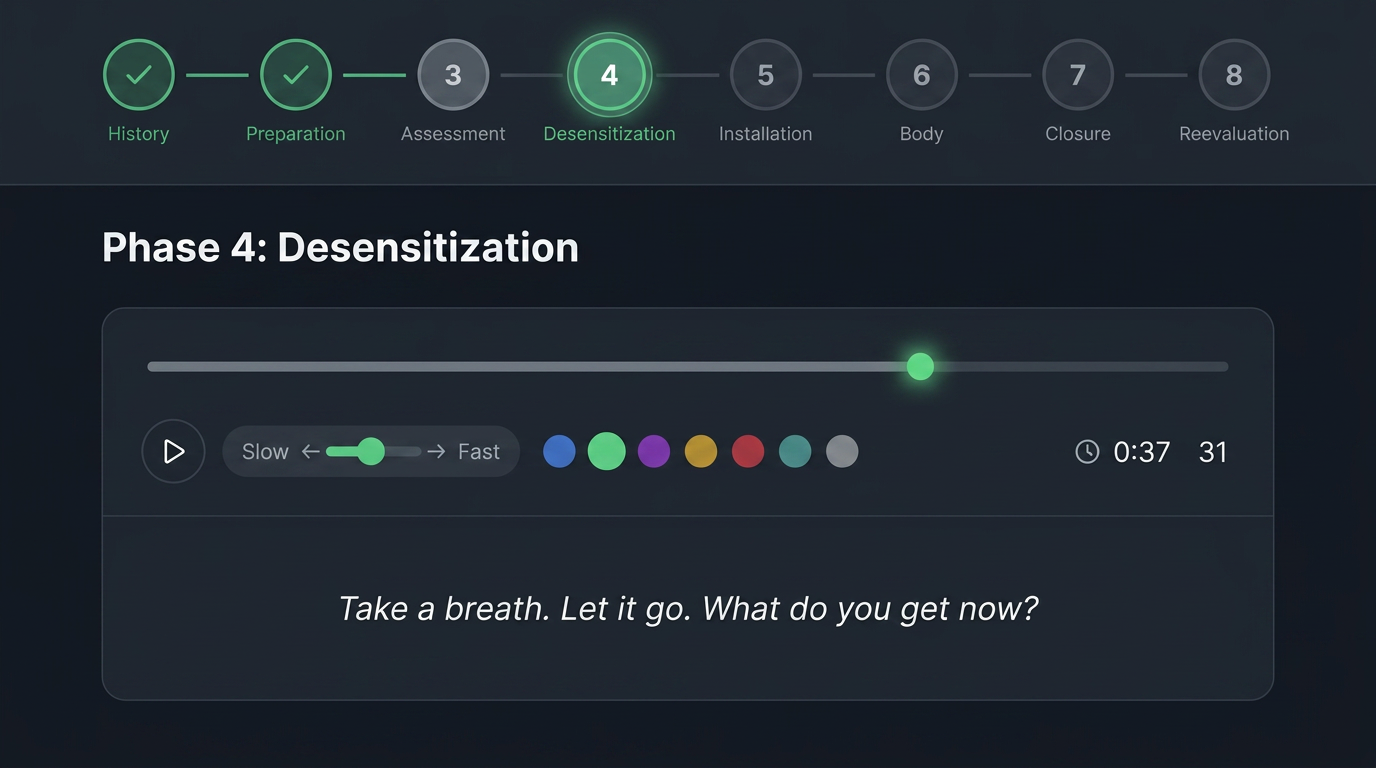
"Take a breath. Let it go. Now bring your attention back to the original picture. What do you get now?"
"On a scale of 0 to 10, how disturbing is it now?"
Closure:
"We're going to stop for today. Let's put the rest of it away in the container until we meet again." Then a calm place installation.
When to use EMD instead of full EMDR
- Recent critical incident, within days or weeks, with no complex trauma history.
- Limited session time — a shortened slot where full channel-following can't be closed safely.
- Fragility: medical instability, active crisis, low affect tolerance, or a first reprocessing session.
- Dissociation risk — screen first and consider extended Phase 2 before any reprocessing.
Stepping up to full EMDR
EMD is a floor, not a ceiling. Once the client demonstrates that they can return to baseline between sets and use resourcing independently, widen to EMDr and then to standard EMDR. Document the shift in your session notes so the rationale is visible in consultation.
Frequently asked questions
What is an EMD script?
EMD is the restricted-processing variant of EMDR: after each short set of bilateral stimulation, the clinician returns the client to the original target image rather than following associative channels, taking a SUD each time.
What is the difference between EMD and EMDR?
EMD returns to the original target after every set, keeping processing narrow. Standard EMDR follows associative channels to their natural end before returning to target. EMDr sits in between.
When should you use EMD?
For acute single-incident trauma, fragile or medically unstable clients, low affect tolerance, dissociation risk, or shortened sessions where full channel-following could not be safely closed down.
Does the SUD have to reach 0 in EMD?
No. EMD is a containment protocol; a session is complete when disturbance has reduced and the client is grounded and closed down, even if the SUD is not 0.
Related tools for EMDR therapists
Try EMDR Assist with your next session
14-day free trial. No credit card. Built by clinicians, for clinicians.