
What an EMDR session note should actually contain
A defensible EMDR session note captures more than the standard SOAP elements. EMDRIA consultation reviewers and most insurance auditors expect to see the protocol-specific data points that prove EMDR was actually performed:
- Phase worked — which of the eight phases the session covered (often more than one)
- Target memory — short label only, never names, initials or identifying detail
- Image, NC, PC, VOC, emotion, body location, baseline SUD — the phase 3 assessment
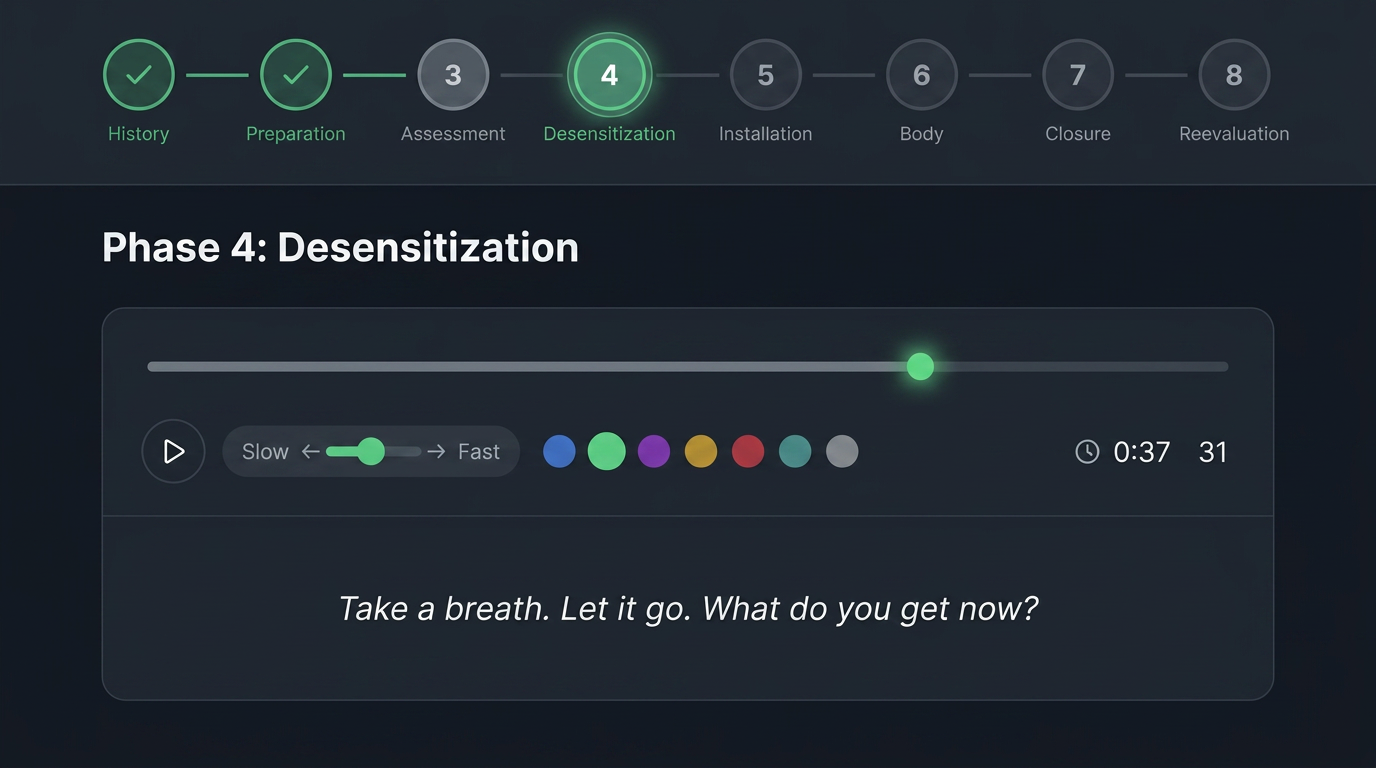
- BLS modality and sets — visual/audio/tactile, speed, number of sets
- Channels processed and ending SUD/VOC — what shifted during desensitization
- Cognitive interweaves used — when the channel was blocked and how you intervened
- Closure status — completed reprocessing vs. incomplete session, container/calm place use
- Plan — next target, homework, between-session monitoring
EMDR Assist captures all of this as you go, then renders a clean PDF you can attach to your EHR note or store separately.
CPT codes for EMDR sessions
EMDR doesn't have a dedicated CPT code in the United States — sessions are billed under standard psychotherapy codes based on time:
- 90832 — 30 minutes (rare for EMDR processing)
- 90834 — 45 minutes
- 90837 — 60 minutes (most common for reprocessing sessions)
- +90785 — interactive complexity add-on (when appropriate)
Reprocessing sessions usually justify 90837 because phase 4 desensitization rarely completes inside 45 minutes. Document the clinical reason for the longer session length in your note.
Free EMDR session note template
Want to write better notes without signing up? Our free progress note template is a one-page PDF with structured fields for every phase 3-7 data point, ready to print or fill in digitally.
For ongoing case load, the EMDR Assist app captures the same fields automatically and renders the PDF for you at session close — no double entry.
References
- Shapiro, F. (2018). Eye Movement Desensitization and Reprocessing (EMDR) Therapy: Basic Principles, Protocols, and Procedures (3rd ed.). Guilford Press. (Phase 3–7 data points documented in the note.)
- American Medical Association. CPT® Professional Edition — psychotherapy codes 90834 / 90837. Verify payer-specific policy before billing.
- EMDR International Association. About EMDR Therapy. Accessed 2026.
- Documentation guidance here is general educational content, not legal, billing, or compliance advice.
Frequently asked questions
What CPT code should I use for EMDR sessions?
Most EMDR reprocessing sessions are billed under CPT 90837 (60 min) because phase 4 desensitization rarely completes inside 45 minutes. Document the clinical justification for the longer session in your note.
Do EMDR session notes need to mention BLS specifically?
Yes. Defensible notes specify the BLS modality (visual, audio, or tactile), speed, and rough number of sets. This documents that EMDR — not generic talk therapy — was actually delivered.
How do I document an incomplete EMDR session?
Note the ending SUD, the channel that was blocked, any container or calm place exercise used at closure, and the planned re-entry point for the next session.
Is there a free EMDR session note template?
Yes — see /resources/progress-note-template for a printable one-page template with structured phase fields.
Where should I store EMDR session notes?
Inside your EHR for billing, with the protocol-specific PDF attached as supporting documentation. EMDR Assist exports the PDF for you.
Related tools for EMDR therapists
Try EMDR Assist with your next session
14-day free trial. No credit card. Built by clinicians, for clinicians.