
Free printable PDF
Cognitive Interweaves Cheat Sheet (PDF)
Every interweave category with example wording — responsibility, safety, choice, education, imagination and somatic — on one printable page.
The short answer
A cognitive interweave is a brief, deliberate clinician statement or question introduced during Phase 4 when processing loops, blocks, or the client cannot get to adaptive information on their own — followed immediately by another set of bilateral stimulation.
Shapiro organizes interweaves around three plateaus: responsibility ("whose fault was it?"), safety ("are you in danger now?"), and choice ("what can you choose today?"). Use the smallest interweave that restarts movement, then get out of the way. See the full Phase 4 guide.
Watch: When processing gets stuck (3:15)
Download the cognitive interweaves PDF (free)
The Cognitive Interweaves Cheat Sheet (free PDF) is a single-page clinician quick-reference with 3–5 example phrasings for each of the six interweave categories — responsibility, safety, choice, education, imagination and somatic — plus a decision-rule panel for when to use one and when to wait. No signup required.
If you want more worked wording, the companion page ships 40 cognitive interweave examples by theme.
What a cognitive interweave is (and isn't)
A cognitive interweave is a deliberate, minimal verbal intervention during phase 4 desensitization used to unstick a blocked channel. It's not a reframe, not psychoeducation, and not a CBT challenge. The job is to introduce a piece of adult information the client's adaptive network already has, then get out of the way and resume BLS.
Shapiro organized interweaves around three developmental plateaus that show up repeatedly in stuck processing: responsibility, safety, and choice.
Responsibility interweaves
For clients carrying inappropriate self-blame (NC: "It's my fault" / "I'm bad"):
- "How old were you when this happened?" → "What can a [age]-year-old do in that situation?"
- "Whose responsibility was it to keep you safe?"
- "If a child you cared about was in that situation, would you blame them?"
- "What did you actually do? What did the adult do?"
Safety interweaves
For clients stuck in present-tense fear of a past event (NC: "I'm in danger" / "I'm not safe"):
- "Are you safe now?" → "Notice where you are right now."
- "How old are you now?" → "What's different now compared to then?"
- "Did you survive?" — orienting to the fact that the event ended
- "Who is with you now who wasn't with you then?"
Choice interweaves
For clients stuck in helplessness (NC: "I have no control" / "I'm powerless"):
- "What choices do you have available to you now?"
- "What would you do differently if it happened today?"
- "What's one small thing you can choose right now?"
- Resource installation: "Bring in [resource figure]. What would they do?"
Decision rules: when to interweave
- Two consecutive sets with no movement — same SUD, same content, no new associations
- Looping — the same image, thought, or affect keeps returning unchanged
- Time pressure — the session is ending and you need to bring SUD down enough for safe closure
- Abreaction without integration — high affect with no cognitive processing happening
When in doubt, wait one more set. EMDR's adaptive information processing model assumes the network wants to move; clinicians who interweave too early often interrupt processing that was about to shift.
Reviewed by the EMDR Assist Clinical Team, EMDR-trained clinicians.
Educational reference material for EMDR-trained clinicians. It does not replace EMDRIA-approved Basic Training, consultation, supervision, or clinical judgement, and it is not medical advice.
References
- Shapiro, F. (2018). Eye Movement Desensitization and Reprocessing (EMDR) Therapy: Basic Principles, Protocols, and Procedures (3rd ed.). Guilford Press.
- Laliotis, D., Luber, M., Oren, U., Shapiro, E., Ichii, M., Hase, M., La Rosa, L., Alter-Reid, K., & St. Jammes, J. T. (2021). What is EMDR therapy? Past, present, and future directions.Journal of EMDR Practice and Research, 15(4), 186–201.
- EMDR International Association (EMDRIA). About EMDR Therapy. Accessed 2026.
Frequently asked questions
What is a cognitive interweave in EMDR?
A cognitive interweave is a deliberate, minimal verbal intervention during phase 4 desensitization that introduces a piece of adult information the client already has, in order to unstick a blocked channel.
When should I use a cognitive interweave?
After two consecutive BLS sets with no movement, when the client is looping on the same content, when time is running out, or when high affect isn't producing cognitive shifts.
What are Shapiro's three interweave plateaus?
Responsibility (for inappropriate self-blame), Safety (for present-tense fear of past events), and Choice (for stuck helplessness).
Can I use too many interweaves?
Yes. Over-interweaving interrupts the adaptive information processing the protocol is designed to unlock. Default to staying out of the way; interweave only when the channel is genuinely stuck.
Where can I find a full library of EMDR interweaves?
Start with the free Cognitive Interweaves Cheat Sheet PDF and the 40 worked examples page on this site. Inside EMDR Assist, the same library is organized by stuck-point theme with one-tap prompts you can reference during session.
Is there a free cognitive interweaves EMDR PDF download?
Yes. The Cognitive Interweaves Cheat Sheet is a free one-page PDF covering responsibility, safety, choice, education, imagination and somatic interweaves, plus a decision-rule panel. No signup is required to download it.
How many types of cognitive interweave are there?
Shapiro's model defines three plateaus — responsibility, safety and choice. Most EMDR Basic Trainings teach six working categories by adding education, imagination and somatic interweaves.
Related tools for EMDR therapists
Free one-page download for the desk.
Worked wording grouped by theme.
Deeper clinical walkthrough with case examples.
When the channel won't move at all.
Interweave library built into the session view.
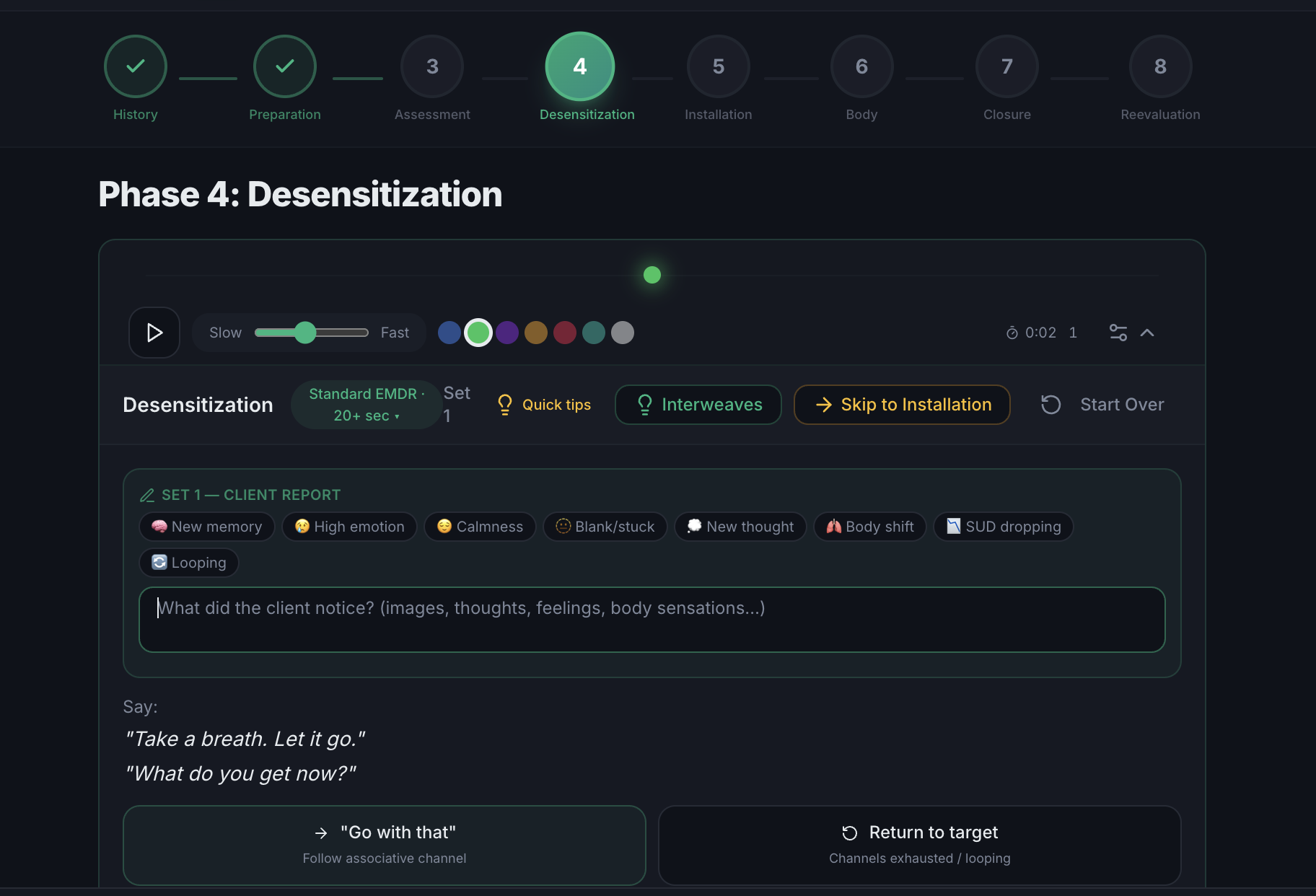
Full reference for desensitization.
Try EMDR Assist with your next session
14-day free trial. No credit card. Built by clinicians, for clinicians.