

The short answer
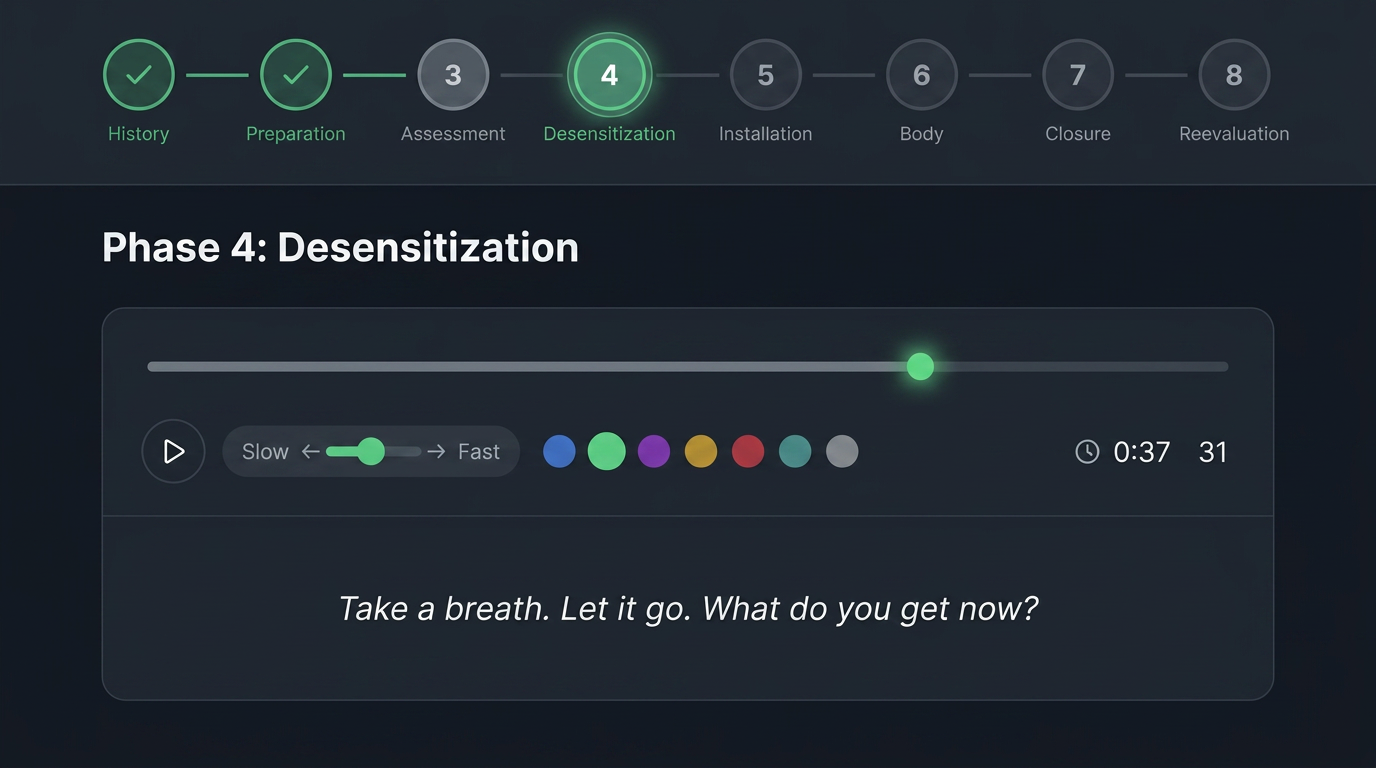
EMDR with children uses the same eight phases as with adults. What changes is the language, the pace, the type of bilateral stimulation and the role of parents. Younger children often use drawing, play, the butterfly hug and feelings faces instead of number scales, and sessions are usually shorter. Teenagers can usually follow something close to the adult protocol.
How EMDR changes for kids
Reviewed by the EMDR Assist Clinical Team, EMDR-trained clinicians.
Educational reference material for EMDR-trained clinicians. It does not replace EMDRIA-approved Basic Training, consultation, supervision, or clinical judgement, and it is not medical advice.
The 8-phase protocol is the same. What changes is the language, the pacing, the BLS modality and the involvement of caregivers. Children reprocess faster than adults — sessions are typically shorter (30–45 minutes for under-10s), targets are smaller, and closure is more concrete (drawing the container, storing the story in a box).
Standard adaptations by age band:
- Ages 3–6 — puppets, drawing, storytelling ("the sticky feeling"), butterfly hug BLS, feelings faces (not numeric SUD)
- Ages 7–11 — narrative + drawing, garden-hose SUD (0–10 imagined as a hose), tappers or self-tapping, PC as a superhero phrase
- Ages 12–17 — closer to the adult protocol, eye-movement BLS or tappers, standard SUD/VoC, more room for autonomy re: parent involvement
Phase 1 & 2 with kids — building safety first
History-taking with kids happens in parallel with parents. Get the trauma history from caregivers and collateral records; get the child's felt sense of "what feels big/sticky/scary now" from the child. Screen for dissociation using the A-DES (adolescents) or CDC (children); pediatric dissociation is under-diagnosed and reprocessing without preparation can destabilize.
Phase 2 preparation with children usually includes: a Safe/Calm Place ("your favorite place"), a Container ("the treasure box we put big feelings in until next time"), a Protector figure, and a stop signal that's playful (raising a stuffed animal, drawing an X). The Phase 2 Resourcing Scripts PDF includes child adaptations.
Phase 3 assessment adapted for kids
Traditional NC/PC wording ("I am bad", "I am worthless") is developmentally inappropriate under age 10. Use pictures, superheroes, and body-based prompts:
- Image — "Show me a picture of the worst part" (child draws or points)
- Negative belief — "When you look at that picture, what does it make you say about you?" Common child NCs: "It's my fault," "I'm a bad kid," "I can't do it," "Nobody likes me"
- Positive belief — "What would you rather feel/think about you?" Child PCs: "I'm a good kid," "It wasn't my fault," "I'm strong"
- SUD — feelings faces (0 = happy, 10 = worst), or the garden-hose scale ("how full is the hose?")
- Body — "Where does it live in your body?" (children point; therapist mirrors)
Phase 4 BLS options for kids
Choose the modality the child can tolerate for 20+ seconds without breaking attention:
- Butterfly hug — self-tapping across the chest; child-led pacing; the pediatric default
- Tappers / buzzers — Neurotek or equivalent; short sets (10–15 alternations)
- Therapist-led tapping — on knees, hands, or shoulders; requires established consent + touch policy
- Drumming or clapping — for kids who can't sit still
- Eye movements — usually age 8+; use a puppet, laser pointer, or wand
Between sets: fewer words. "What are you noticing?" "Go with that." Follow the child's associations, not your own theory of the memory.
Parent involvement — when to include, when to protect the space
Parent involvement is protocol-relevant, not optional. Younger children often need a parent in the room (or immediately outside) to co-regulate. Adolescents typically need the parent out for the trauma work and in for the psychoeducation, planning and closure portions.
Standard practice:
- Under 7 — parent in room, coached in advance not to answer for the child
- 7–11 — parent typically in for Phase 1/2 and closure; out for Phase 3/4 unless attachment work indicates otherwise
- 12+ — parent out for reprocessing; brief joint check-ins as clinically indicated
Send parents home with a between-session log so they can flag dysregulation early. The Between-Session Client Log works with minor wording changes.
Free EMDR for Kids PDFs
The EMDR for Kids PDF bundle includes a child-friendly "What is EMDR" handout, a feelings-face SUD scale, a container-drawing worksheet, and a parent consent + involvement guide. All free, all printable, and all designed for a working pediatric caseload.
References & clinical use
Clinical use notice. This page is educational reference material for EMDR-trained clinicians. Child and adolescent EMDR requires training beyond the adult Basic Training curriculum, and nothing here replaces consultation, supervision, or your own clinical judgement. Screening cutoffs are triage guides, not diagnoses. Training-hour and credential figures are summarised from EMDRIA's published standards and are revised periodically — verify them against the current EMDRIA materials.
- Adler-Tapia, R., & Settle, C. (2017). EMDR and the Art of Psychotherapy with Children (2nd ed.). Springer — age-banded adaptations, SUD/VoC alternatives, caregiver involvement.
- Gomez, A. M. (2013). EMDR Therapy and Adjunct Approaches with Children: Complex Trauma, Attachment, and Dissociation. Springer.
- Shapiro, F. (2018). Eye Movement Desensitization and Reprocessing (EMDR) Therapy (3rd ed.). Guilford Press — the standard 8-phase protocol these adaptations preserve.
- Armstrong, J. G., Putnam, F. W., Carlson, E. B., et al. (1997). Development and validation of a measure of adolescent dissociation: The Adolescent Dissociative Experiences Scale (A-DES). Journal of Nervous and Mental Disease, 185(8), 491–497.
- Putnam, F. W., Helmers, K., & Trickett, P. K. (1993). Development, reliability and validity of a child dissociation scale (CDC). Child Abuse & Neglect, 17(6), 731–741.
- de Roos, C., van der Oord, S., Zijlstra, B., et al. (2017). Comparison of EMDR therapy, cognitive behavioral writing therapy, and wait-list in pediatric PTSD following single-incident trauma. Journal of Child Psychology and Psychiatry, 58(11), 1219–1228.
- EMDR International Association (EMDRIA). Child and adolescent EMDR training and specialty credential requirements. emdria.org (verify the current edition).
Frequently asked questions
What age can you start EMDR with children?
EMDR has been used with children as young as 2–3 with heavy modification (drawing, storytelling, parent-mediated BLS). The standard protocol is developmentally appropriate from around age 7 with the adaptations described above.
How long is an EMDR session with a child?
Typically 30–45 minutes for under-10s and 45–60 minutes for adolescents. Children reprocess faster than adults but tolerate less sustained attention.
Should the parent be in the room during EMDR?
It depends on age and the trauma. Under 7, usually yes. 7–11, usually out for reprocessing but in for Phase 1/2/7. 12+, out for reprocessing with joint check-ins. When the parent is part of the trauma (attachment injuries), the decision is more nuanced and belongs in the treatment plan.
Do I need extra training to do EMDR with kids?
Yes. EMDRIA-approved child/adolescent EMDR training (typically 24 hours beyond Basic Training) is strongly recommended before working with under-12s. The developmental adaptations are more than a language change.
What BLS works best for kids?
Butterfly hug is the pediatric default — self-paced, no touch, no equipment. Tappers work well for 8+. Eye movements typically require a puppet or wand to hold attention.
Related tools for EMDR therapists
Try EMDR Assist with your next session
14-day free trial. No credit card. Built by clinicians, for clinicians.