
Download the template
Download the EMDR Treatment Plan Template (PDF) — free, no signup, no email required.
Reviewed by the EMDR Assist Clinical Team, EMDR-trained clinicians.
Educational reference material for EMDR-trained clinicians. It does not replace EMDRIA-approved Basic Training, consultation, supervision, or clinical judgement, and it is not medical advice.
What an EMDR treatment plan contains
- Client and episode details — diagnosis, format, frequency.
- Presenting problem and history — symptoms, adversity history, risk, dissociation screen.
- AIP case conceptualisation — touchstone memory, core negative cognition, desired positive cognition, present triggers, blocked future goals.
- Readiness checklist — consent, affect tolerance, dual attention, safety planning.
- Three-pronged target sequence — past, present, future targets in processing order.
- Outcome measures and review points — baseline, mid-point, discharge.
How to sequence the targets
Within each cluster, sequence past → present → future (Shapiro, 2018). Start with the touchstone memory when the client can tolerate it; otherwise begin with a less charged past target in the same cluster and return. Record baseline SUD and VoC at Phase 3 assessment, not at planning — ratings taken in advance drift. Re-sequence whenever new material emerges in Phase 4, and document why.
Keeping the plan live instead of filed
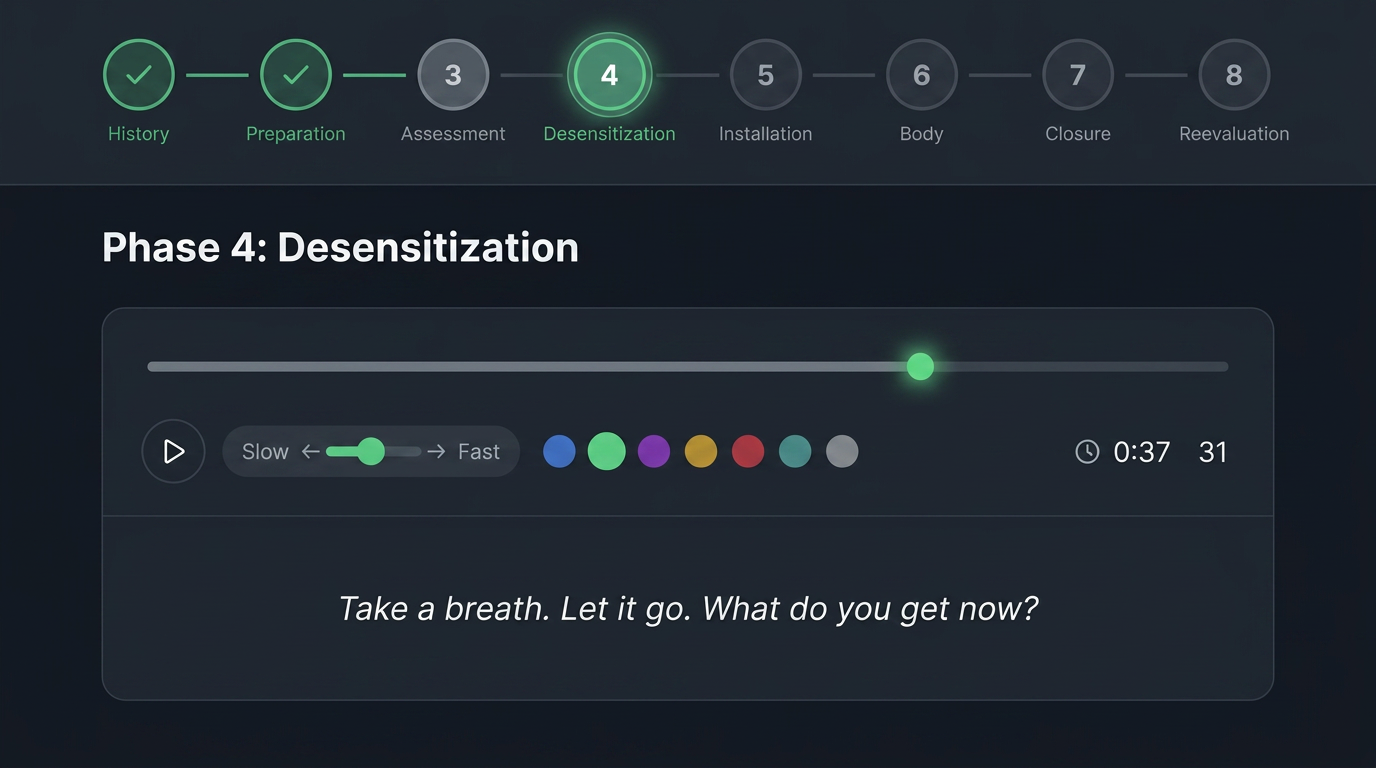
The most common failure is a plan written once and never revisited. In EMDR Assist, the target sequence plan is the working surface: targets carry status, SUD and VoC update from live sessions, and new targets surfaced during reprocessing can be added to the plan without leaving the session.
Frequently asked questions
Is the EMDR treatment plan template free?
Yes — the PDF is free to download with no signup, no email, and no paywall. Print it or complete it on screen.
What goes in an EMDR treatment plan?
Client and episode details, presenting problem and history, an AIP case conceptualisation (touchstone memory, negative and positive cognitions), a readiness and stabilisation checklist, a three-pronged past/present/future target sequence, and outcome measures with review points.
When should I write the EMDR treatment plan?
After Phase 1 history-taking, before Phase 2 preparation is complete. Revise it every 6–8 sessions and whenever new targets emerge during reprocessing.
How do I sequence targets in EMDR?
Sequence past, then present, then future within each cluster. Begin with the touchstone memory when the client can tolerate it, retest present triggers after past targets resolve, and install the future template last.
Can I use this template without EMDR training?
No. EMDR requires EMDRIA-approved Basic Training. The template is reference material for trained clinicians and does not replace training, consultation, or supervision.
Related tools for EMDR therapists
Try EMDR Assist with your next session
14-day free trial. No credit card. Built by clinicians, for clinicians.