
Download the annotated example
Download the EMDR Progress Note Example (PDF) — worked note, annotations, blank template. Free, no signup.
Reviewed by the EMDR Assist Clinical Team, EMDR-trained clinicians.
Educational reference material for EMDR-trained clinicians. It does not replace EMDRIA-approved Basic Training, consultation, supervision, or clinical judgement, and it is not medical advice.
The example is fictional and de-identified. It is not legal or billing advice and does not replace your jurisdiction's documentation requirements or your payer's rules.
The example note (D — Data)
Client presented alert and oriented, reported sleep 5–6 hrs/night and two intrusions since last session. Re-accessed the agreed target from the treatment plan: "moment of impact, collision." Phase 3 markers re-checked at start: NC "I'm not safe," PC "I'm safe now," VoC 3/7, SUD 8/10, body location chest and jaw. Bilateral stimulation: horizontal eye movements via light bar, fast, approx. 26 passes per set, 14 sets. Channels included the impact image, then a related childhood memory; therapist returned client to target twice when the channel emptied. One cognitive interweave (responsibility) after two sets with no change. End-of-session SUD 4/10; VoC not re-rated (installation not begun). Session ended incomplete by time. Closure: container and calm place, 3 minutes; grounding rated 8/10, no dissociation. Risk screen: denied suicidal ideation, self-harm, and substance use.
The Assessment and Plan sections, plus the header with times and CPT code, are in the PDF.
What each element defends
- Start/stop times — supports the billed 90837 time threshold.
- Diagnosis plus current symptoms — medical necessity for continued treatment.
- Named phase and procedure — shows a specific, skilled intervention.
- SUD start and end, VoC status — objective measure of response.
- BLS modality, speed, set count — reproducible record of the procedure.
- Interweave and returns to target — documents clinical decision-making.
- Closure steps — demonstrates the standard of care after an incomplete session.
Generating notes from the session itself
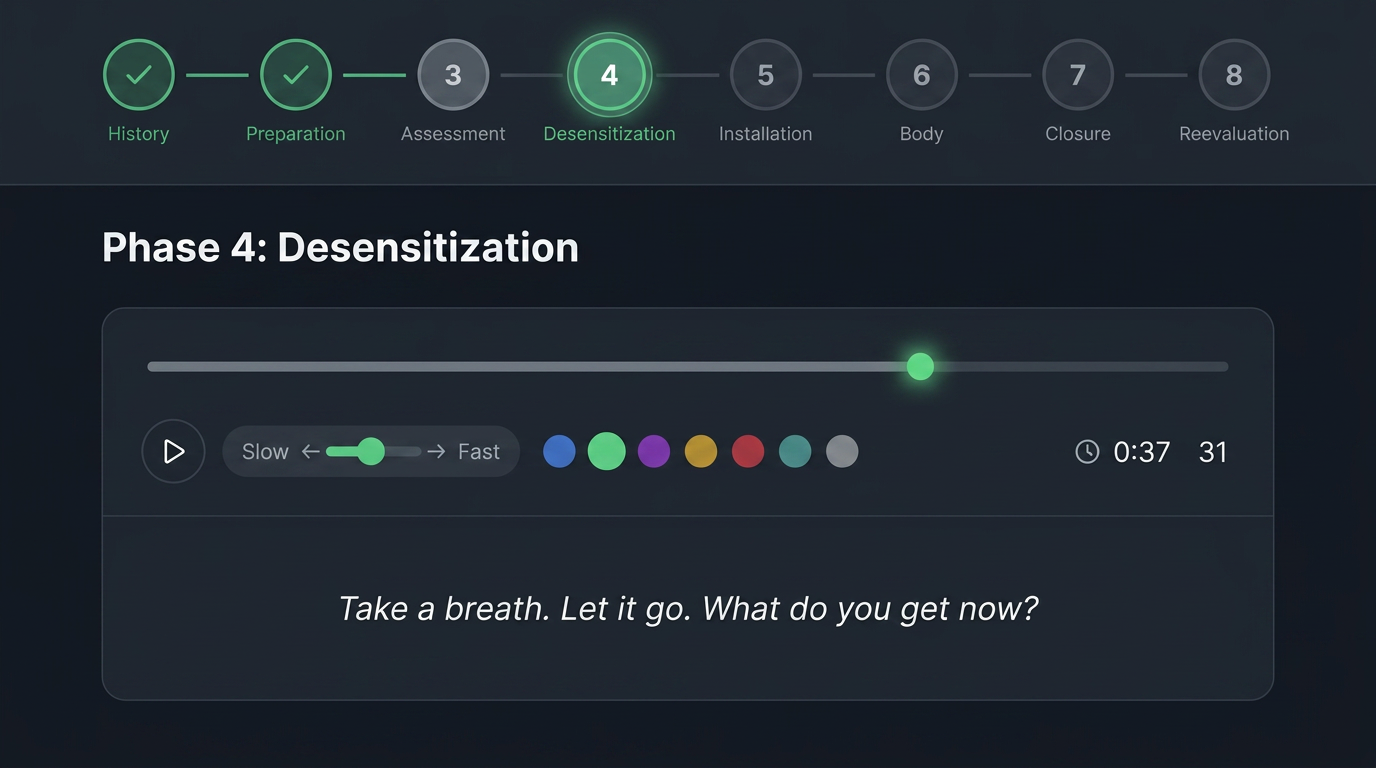
Everything in the example above is captured structurally during a guided session in EMDR Assist — phase, target, NC/PC, SUD and VoC arcs, BLS parameters, body scan and closure — so the note is drafted from what actually happened rather than reconstructed at the end of the day. See also the progress notes guide.
Frequently asked questions
What does an EMDR progress note look like?
A DAP note with a header (date, start/stop times, CPT code, diagnosis, phases worked), a Data section recording the target, NC/PC, SUD and VoC at start and end, BLS modality and set count, interweaves, body scan and closure, an Assessment of response to intervention, and a Plan for the next session.
How do you document an incomplete EMDR session?
Record the end-of-session SUD, state explicitly that the session ended incomplete, and document the closure procedure used (container, calm place, grounding) with the client's post-closure state. Then plan to resume the target with a re-rated SUD next session.
Should I write the trauma narrative in the note?
No. Record the target label, ratings, procedure and response. Verbatim trauma detail that is not clinically necessary increases risk without improving the record.
What CPT code is used for EMDR?
EMDR is typically billed as psychotherapy — commonly CPT 90837 for 60 minutes — with documented start and stop times and an appropriate diagnosis. Confirm requirements with your payer and jurisdiction.
Is DAP or SOAP better for EMDR notes?
Most EMDR clinicians prefer DAP because it captures the SUD and VoC arc cleanly. SOAP works but forces a subjective/objective split that does not map onto EMDR phases.
Related tools for EMDR therapists
Try EMDR Assist with your next session
14-day free trial. No credit card. Built by clinicians, for clinicians.