

Quick comparison — at a glance
Five platforms dominate the EMDR software market in 2026. They differ wildly in scope: some are full session co-pilots, some are pure bilateral stimulation (BLS) delivery tools, and one is a CE-marked European medical device. Here's how the core features stack up.
| Feature | EMDR Assist | EMDRSuite | EMDR Platform | WeMind | Bilateral Base |
|---|---|---|---|---|---|
| Free plan available | |||||
| Starting price (USD/mo) | $0 | $29 | €39 | $49 | $0 |
| Visual BLS | |||||
| Audio BLS | |||||
| Tactile / pacing cue | |||||
| 8-phase guided workflow | |||||
| SUD / VOC tracking & charts | |||||
| Target sequence planner | |||||
| Cognitive interweave library | |||||
| Auto PDF session reports | |||||
| Consultation hour tracking | |||||
| EMDR intensives mode | Beta | ||||
| Client-shared telehealth screen | |||||
| No client PII required | |||||
| Built by EMDR therapists |
Legend: ✓ supported · — partial / limited · ✗ not available. Pricing as of June 2026; check each vendor for current rates.
How to choose — by practice type
The "best" EMDR software depends almost entirely on what your practice looks like. Here's the short version:
- Solo therapist starting EMDR — start with EMDR Assist's free plan. You get BLS, basic phase guidance, and the 8-phase reference, with zero financial commitment while you decide whether the workflow fits.
- Established EMDR-only practice — EMDR Assist (Pro or Clinical) or EMDRSuite. Both handle structured phase capture; EMDR Assist adds target sequence planning, consultation logging, and interweave libraries that EMDRSuite lacks.
- European / GDPR-required practice — EMDR Platform is CE-marked as a medical device. That carries weight in the EU but adds cost and onboarding friction.
- Telehealth-first — any of EMDR Assist, EMDRSuite, EMDR Platform, or WeMind work. EMDR Assist's client-share screen is link-based (no app install for the client), which is the lowest-friction option.
- EMDRIA consultant or CIT — EMDR Assist is the only platform with built-in consultation hour tracking and consultee management aligned to EMDRIA requirements.
- Just need a free BLS tool for a single session — use the free bilateral stimulation tool or Bilateral Base. No account needed for either.
EMDR Assist — overview
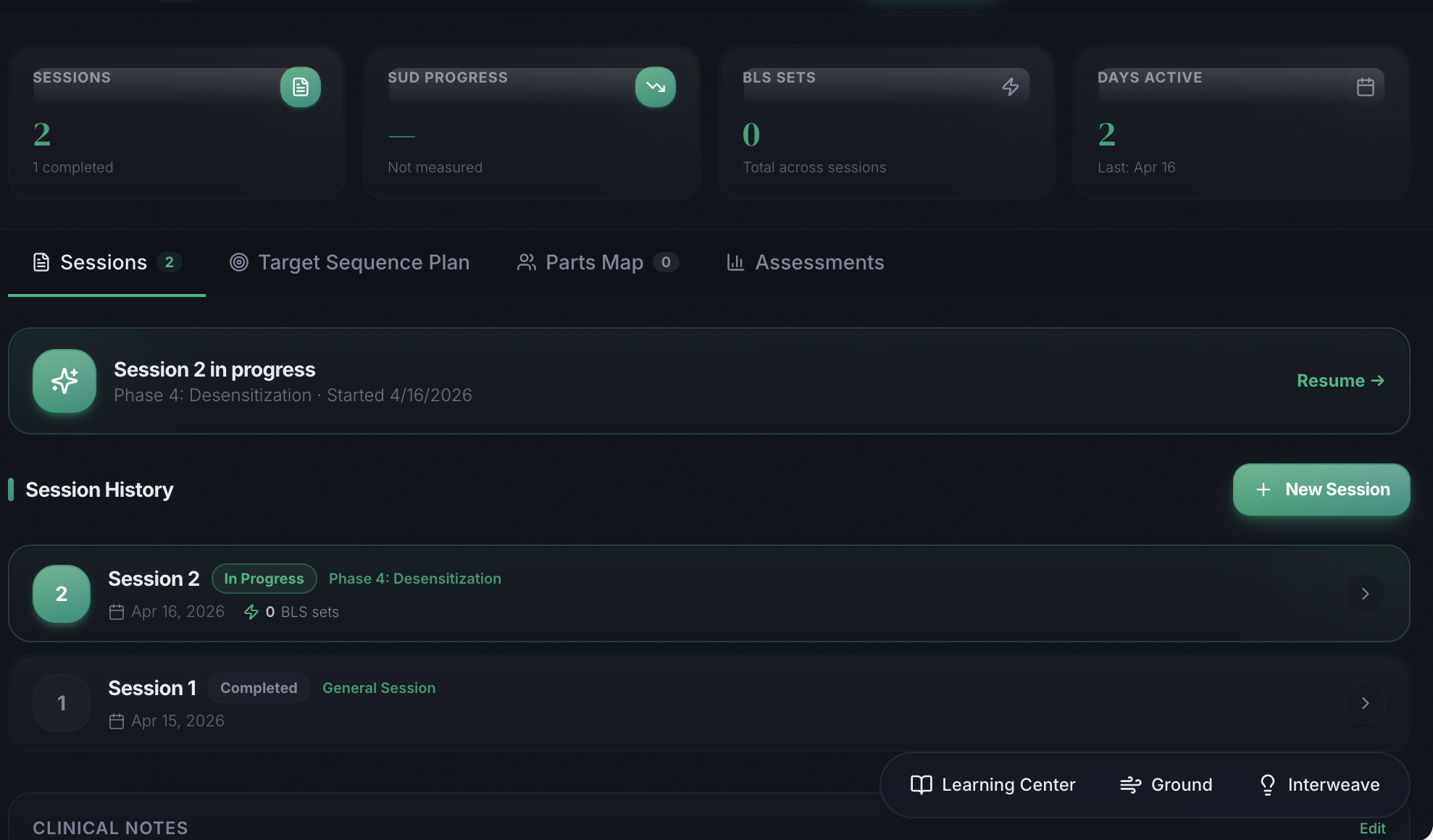
EMDR Assist is the most opinionated of the five — built around the 8-phase protocol from the first screen. Every session view shows the current phase, the next step, and the relevant script. SUD/VOC capture, cognitive interweaves, target sequence planning, and PDF documentation are first-class features rather than add-ons.
Best for: EMDR therapists who want a clinical co-pilot, not just a BLS tool. Privacy-first (no PII required), free tier exists, and consultation hour tracking is built in for EMDRIA CITs and consultants.
Trade-offs: Not an EHR — you'll still need a system for billing and intake forms. Newer than EMDRSuite, so the user base is smaller (~hundreds of active clinicians as of mid-2026).
Pricing: Free forever plan; Pro and Clinical tiers add full guides, PDFs, and a BAA. See features →
EMDRSuite — overview
EMDRSuite is the most established remote-EMDR tool. It pairs BLS with a video call, with reasonable session structure on top.
Best for: Therapists who want a single-vendor video + BLS combo and don't need deep phase-specific structure or consultation tracking.
Trade-offs: No free tier. Limited cognitive interweave support. Target sequence planning is informal. See the full EMDR Assist vs EMDRSuite comparison →
EMDR Platform — overview
EMDR Platform (emdr-platform.com) is a European, GDPR-compliant, CE-marked medical device. The medical-device classification is rare in this category and reassuring for EU clinicians.
Best for: European practices with regulatory requirements that favor a CE-marked device.
Trade-offs: Higher price point, longer onboarding, English documentation is thinner than competitors. EMDR Assist vs EMDR Platform →
WeMind Therapy — overview
WeMind positions itself as "next generation" EMDR software, with insurer backing in some markets and a polished UI.
Best for: Group practices with an existing insurer relationship that integrates with WeMind.
Trade-offs: Higher monthly cost, no free tier, requires client PII for full functionality. EMDR Assist vs WeMind →
Bilateral Base — overview
Bilateral Base is a free, browser-based BLS tool. It does one thing: bilateral stimulation in the browser.
Best for: Therapists who already have an EHR and clinical workflow they like and just need a quick BLS layer.
Trade-offs: No phase structure, no SUD/VOC capture, no documentation. EMDR Assist's free tier covers everything Bilateral Base does, plus phase guidance and SUD tracking.
What we don't recommend
A surprising number of practices still use a generic EHR (SimplePractice, TherapyNotes) plus a YouTube BLS video. This works mechanically, but you lose the structured phase capture that's specifically what supervisors and EMDRIA reviewers want to see. If you're billing as an EMDR specialist, your documentation should reflect the protocol.
Methodology
This comparison was written by a licensed EMDR-trained therapist who actively sees clients and works directly with the EMDR Assist product. Features were verified against each vendor's public documentation and (where available) hands-on trial accounts as of June 2026. Pricing is list-price for the lowest individual-practitioner tier. We disclose our bias: we make the EMDR Assist platform. Where we've called a competitor better, we mean it.
Frequently asked questions
What is the best EMDR therapy software for solo practitioners in 2026?
For solo EMDR practitioners, EMDR Assist offers the lowest barrier to entry — a free tier with full BLS and phase guidance, no client PII required, and built-in consultation hour tracking. EMDRSuite is the strongest established alternative but has no free plan.
Is EMDR software secure for clinical use?
It depends on the vendor and plan. EMDR Assist is built with privacy-conscious architecture and encrypts data at rest and in transit. EMDRSuite, WeMind, and EMDR Platform also offer security agreements on higher tiers. Always verify the vendor's security posture before storing any PHI.
Do I need EMDR software or just a BLS tool?
If you only do occasional EMDR and have a working clinical workflow elsewhere, a free BLS tool is enough. If EMDR is a regular part of your practice, dedicated EMDR software pays back through faster, more protocol-faithful documentation and structured target tracking.
Can EMDR software replace my EHR?
No — and you shouldn't expect it to. EMDR software handles the session-level workflow (BLS, phase capture, SUD/VOC, PDF export). Your EHR continues to handle billing, intake, and the formal medical record. EMDR Assist's PDF exports are designed to attach into any EHR's note.
What about open-source or free options?
Bilateral Base and EMDR Assist's free tier are the most credible no-cost options. We don't recommend cobbling together a YouTube BLS video and a Word doc — it works, but you lose the structured documentation that justifies EMDR as a specialty.
Related tools for EMDR therapists
Side-by-side comparison of EMDR Assist and EMDRSuite.
How EMDR Assist compares to EMDR Platform.
Detailed comparison vs WeMind Therapy.
Features, pricing, and how the workflow fits the 8 phases.
Try bilateral stimulation in your browser, no signup.
Free clinical guides on every phase of EMDR.
Try EMDR Assist with your next session
14-day free trial. No credit card. Built by clinicians, for clinicians.