

EMDR Assist is not affiliated with or endorsed by the developers of EMDR 2.0 (Ad de Jongh, Suzy Matthijssen and colleagues). This page summarises published research in our own words. Learn the protocol through the developers' training.
The short answer
EMDR 2.0 is a set of refinements to standard EMDR developed by Ad de Jongh and Suzy Matthijssen. It keeps Shapiro's eight phases but adds extra tasks during desensitization to load working memory harder, and puts more emphasis on motivation and full activation of the memory. In the one randomized lab comparison so far, it worked as well as standard EMDR with fewer sets (Matthijssen et al., 2021).
What is EMDR 2.0?
EMDR 2.0 is a set of procedural refinements to standard EMDR developed by Dutch clinician-researchers Ad de Jongh and Suzy Matthijssen. It is not a new therapy — it keeps Shapiro's eight-phase framework — but it intentionally increases the working-memory load during Phase 4 (desensitization) by layering additional cognitive tasks on top of bilateral stimulation. The goal is to push the client closer to the point where they can just barely hold the target memory in mind. Its developers also emphasise motivation (addressing avoidance) and fuller activation of the memory. In the one randomized lab comparison so far, it worked as well as standard EMDR with fewer sets (Matthijssen et al., 2021).
Reviewed by the EMDR Assist Clinical Team, EMDR-trained clinicians.
Educational reference material for EMDR-trained clinicians. It does not replace EMDRIA-approved Basic Training, consultation, supervision, or clinical judgement, and it is not medical advice.
The theory: why taxing working memory works
The dominant mechanistic account of EMDR is the working-memory (WM) theory (Andrade, Kavanagh & Baddeley, 1997; van den Hout & Engelhard, 2012). Holding a vivid autobiographical memory in mind draws on limited-capacity working memory, particularly the visuospatial sketchpad. When a competing task taxes the same resources at the same time, the reconsolidated memory returns to storage less vivid and less emotional.
Working-memory theory predicts that a more taxing secondary task should reduce memory ratings more, up to the point where the client can no longer keep the memory in mind (van den Hout & Engelhard, 2012). EMDR 2.0 deliberately raises the load on that basis. Lab evidence that heavier tasks add benefit is mixed (Mertens et al., 2019).
EMDR 2.0 vs standard EMDR — what actually changes
| Element | Standard EMDR | EMDR 2.0 |
|---|---|---|
| Working-memory load | Eye movements only | Layered — BLS plus arithmetic, backward counting, WM games, dual sensory tasks |
| BLS speed & variety | Steady, clinician-paced | Faster, variable speed, direction and modality |
| Set length | ~30–60 seconds | Often shorter, more intense, more frequent check-ins |
| Client role | Passive tracking | Active — instructed to keep the image maximally vivid while taxed |
| Delivery format | Individual sessions | Individual, intensive, and group formats trialled |
The evidence base to date
- Matthijssen, Brouwers, van Roozendaal, Vuister & de Jongh (2021) — randomized lab study (N = 62, non-clinical adults): EMDR 2.0 and standard EMDR reduced the emotionality and vividness of a disturbing memory equally, with no difference in session time; the EMDR 2.0 group needed fewer sets.
- Clinical reports — case reports and uncontrolled studies of intensive programmes that combine EMDR 2.0 with prolonged exposure (for example Matthijssen & Menses, 2024, a single-patient online case report). None has a comparison group.
- Mertens, Lund & Engelhard (2021) — meta-analysis of 53 laboratory studies: dual tasks while recalling a memory reduce its vividness and emotionality. Whether heavier tasks add benefit is less clear (Mertens et al., 2019, found comparable effects across eye-movement tasks of different load).
- The ENHANCE trial (Alting van Geusau et al., 2023, study protocol) — a randomized trial of 130 patients with PTSD comparing six sessions of EMDR, EMDR 2.0 and the Flash technique; the first RCT of EMDR 2.0 in a diagnosed PTSD sample.
Findings are drawn from small-to-moderate samples. Interpret as promising rather than definitive until large confirmatory trials report out.
Clinical implications
- Efficiency. Preliminary data suggest greater per-minute change in memory vividness — potentially useful in intensive or time-limited formats.
- Titration matters. The therapeutic window is the point at which the client can just barely hold the memory in mind. Overload collapses recall and stalls reprocessing; underload wastes the mechanism.
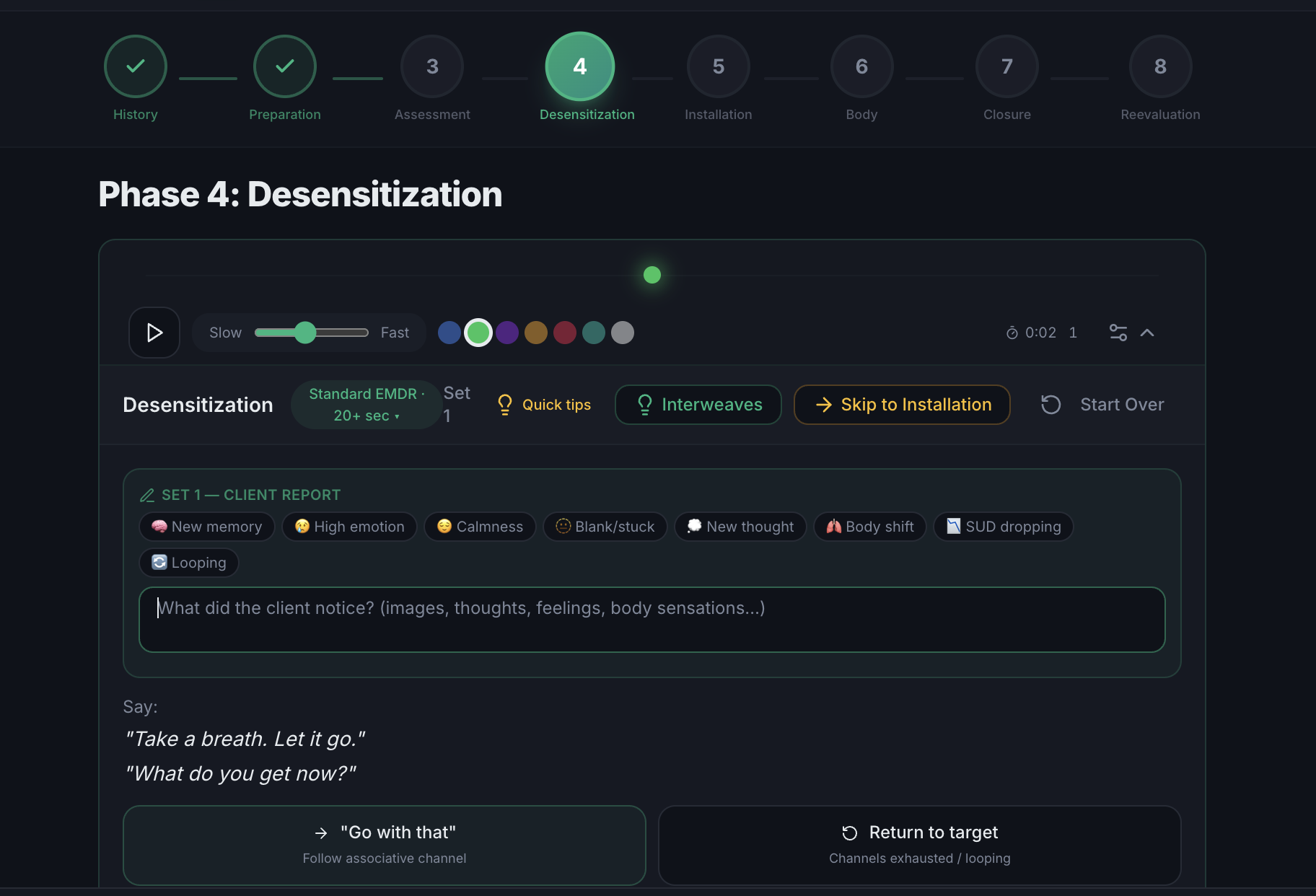
- Fidelity to phases. EMDR 2.0 modifies Phase 4 but does not replace history-taking, preparation, assessment, installation, body scan, closure, or reevaluation. See the standard 8-phase protocol for the base.
- Stabilisation still applies. Highly dissociative or under-resourced clients may need more Phase 2 work before tolerating higher WM loads.
- Not yet a standard of care. EMDRIA and EMDR Europe have not adopted EMDR 2.0 as the reference protocol; treat it as an evidence-informed variation with documented rationale.
Free EMDR 2.0 science brief (PDF)
A shareable, referenced two-page brief covering the working-memory theory, evidence table, procedural changes, and clinical implications — written for trained EMDR clinicians.
Download the EMDR 2.0 science brief (PDF)
More EMDR 2.0 clinician PDFs (with references):
- Clinical Primer PDF — theory, procedural differences, contraindications, references.
- Phase 4 session guide PDF — sample prompts for sets with working-memory tasks.
- Dual-Task Menu & Load Ladder PDF — 25 tasks graded 1–8 with escalation rules.
- Titration Worksheet PDF — set-by-set log with decision rules.
Related printable tools
All resources- EMDR Script PDF — Free 8-Phase Protocol Script for CliniciansA free EMDR script PDF for clinicians: the standard 8-phase protocol on one desk reference — suggested therapist wording, procedural cues and stall-recovery prompts on a single PDF you can keep on your desk.
- EMDR Phase 3 Assessment WorksheetA printable Phase 3 worksheet to capture Image, NC, PC, VoC, Emotion, SUD and body location for a single target — with the standard NC/PC cluster table on the back.
- EMDR Session Processing LogA live clinician log for Phase 4–6 reprocessing — record each BLS set, what came up, the SUD trajectory, interweaves used, Installation, Body Scan and closure.
- EMDR Resourcing Scripts PDF — Free Phase 2 DownloadA free EMDR resourcing scripts PDF — five Phase 2 scripts on a single sheet: Calm Place, Container, and Resource Development & Installation for Nurturing, Protective and Wise figures.
- Cognitive Interweaves EMDR PDF — Free Cheat Sheet DownloadFree cognitive interweaves EMDR PDF — a clinician quick-reference for unblocking stalled Phase 4 processing, with example interweaves across responsibility, safety, choice, education, imagination and somatic prompts.
- EMDR Phase 6 Body Scan & Somatic Tracking WorksheetA printable Phase 6 companion sheet — somatic map, BLS-set tracking, residual-sensation interweaves, and end-of-session closure check on a single sheet per completed target.
References
- Andrade, J., Kavanagh, D., & Baddeley, A. (1997). Eye-movements and visual imagery: A working memory approach to the treatment of post-traumatic stress disorder. British Journal of Clinical Psychology, 36(2), 209–223.
- Alting van Geusau, V. V. P., de Jongh, A., Nuijs, M. D., Brouwers, T. C., Moerbeek, M., & Matthijssen, S. J. M. A. (2023). The effectiveness, efficiency, and acceptability of EMDR vs. EMDR 2.0 vs. the Flash technique in the treatment of patients with PTSD: study protocol for the ENHANCE randomized controlled trial. Frontiers in Psychiatry, 14, 1278052.
- Engelhard, I. M., van den Hout, M. A., & Smeets, M. A. M. (2011). Taxing working memory reduces vividness and emotional intensity of images about the Queen's Day tragedy. Journal of Behavior Therapy and Experimental Psychiatry, 42(1), 32–37.
- Matthijssen, S. J. M. A., Brouwers, T., van Roozendaal, C., Vuister, T., & de Jongh, A. (2021). The effect of EMDR versus EMDR 2.0 on emotionality and vividness of aversive memories in a non-clinical sample. European Journal of Psychotraumatology, 12(1), 1956793.
- Matthijssen, S. J. M. A., & Menses, S. D. F. (2024). Case report: Intensive online trauma treatment combining prolonged exposure and EMDR 2.0 in a patient with severe and chronic PTSD. Frontiers in Psychiatry, 15, 1370358.
- Mertens, G., Krypotos, A.-M., van Logtestijn, A., Landkroon, E., van Veen, S. C., & Engelhard, I. M. (2019). Changing negative autobiographical memories in the lab: A comparison of three eye-movement tasks. Memory, 27(3), 295–305.
- Mertens, G., Lund, M., & Engelhard, I. M. (2021). The effectiveness of dual-task interventions for modulating emotional memories in the laboratory: A meta-analysis. Acta Psychologica, 220, 103424.
- Shapiro, F. (2018). Eye Movement Desensitization and Reprocessing (EMDR) Therapy: Basic Principles, Protocols, and Procedures (3rd ed.). Guilford Press.
- van den Hout, M. A., & Engelhard, I. M. (2012). How does EMDR work? Journal of Experimental Psychopathology, 3(5), 724–738.
Frequently asked questions
What is EMDR 2.0?
EMDR 2.0 is a refinement of standard EMDR developed by Ad de Jongh and Suzy Matthijssen. It keeps Shapiro's eight-phase framework but adds cognitively demanding tasks (mental arithmetic, backward counting, dual sensory tasks) on top of bilateral stimulation during Phase 4, to increase working-memory load and push per-minute change.
How is EMDR 2.0 different from standard EMDR?
EMDR 2.0 keeps the eight-phase structure. Its developers describe three areas of change: motivation (addressing avoidance before processing), activation (bringing the memory up as fully as possible) and desensitization (more taxing, more varied dual tasks during sets).
Is EMDR 2.0 evidence-based?
The evidence is early. One randomized lab study in non-clinical adults (Matthijssen et al., 2021) found EMDR 2.0 as effective as standard EMDR with fewer sets, and case reports and uncontrolled clinical studies describe its use in intensive PTSD programmes. The first RCT in patients with PTSD (the ENHANCE trial) is under way.
Is EMDR 2.0 approved by EMDRIA?
No. EMDRIA and EMDR Europe recognise Shapiro's standard eight-phase protocol as the reference model. EMDR 2.0 is an evidence-informed variation that clinicians use with documented clinical rationale, not a certifying-body standard of care.
Where can I train in EMDR 2.0?
EMDR 2.0 training is offered directly by de Jongh, Matthijssen and colleagues, and through several EMDR Europe-affiliated training providers as a post-basic workshop. Basic EMDR training remains a prerequisite.
Can I use EMDR 2.0 with dissociative clients?
Use caution. The higher cognitive load can be destabilising for under-resourced or highly dissociative clients. Complete Phase 2 stabilisation first, screen with an instrument such as the DES-II, and start with modest load increments before escalating.
Does EMDR 2.0 replace bilateral stimulation?
No. Bilateral stimulation stays; EMDR 2.0 adds further working-memory-taxing tasks on top. The theoretical claim is that eye movements are one instance of a broader mechanism — dual-task interference on visuospatial working memory — and that adding load amplifies the effect.
How long does EMDR 2.0 treatment take?
Session structure varies. Trials of intensive formats have delivered EMDR 2.0 in 4-day blocks; standard outpatient use runs on a similar schedule to standard EMDR. The efficiency claim is per-minute change within Phase 4, not necessarily fewer total sessions.
Related tools for EMDR therapists
Working-memory tasks, BLS variations, and exercises.
The Shapiro protocol EMDR 2.0 builds on.
The phase EMDR 2.0 actually modifies.
Bilateral stimulation for Phase 4 sets.
Every phase, technique, and protocol variation.
Try EMDR Assist with your next session
14-day free trial. No credit card. Built by clinicians, for clinicians.