
What is the standard EMDR protocol?
The standard EMDR protocol is Francine Shapiro's eight-phase model for Eye Movement Desensitization and Reprocessing therapy. Its phases are: History Taking, Preparation, Assessment, Desensitization, Installation, Body Scan, Closure, and Reevaluation. It's the foundation of EMDRIA-approved basic training and the reference point every EMDR variation (Recent Events, Attachment-Focused, EMDR with Children) adapts from.
Reviewed by the EMDR Assist Clinical Team, EMDR-trained clinicians.
Educational reference material for EMDR-trained clinicians. It does not replace EMDRIA-approved Basic Training, consultation, supervision, or clinical judgement, and it is not medical advice.
The 8 phases at a glance
- Phase 1 — History Taking: gather history, identify targets, screen for dissociation
- Phase 2 — Preparation: explain EMDR, install resources (calm place, container), test BLS
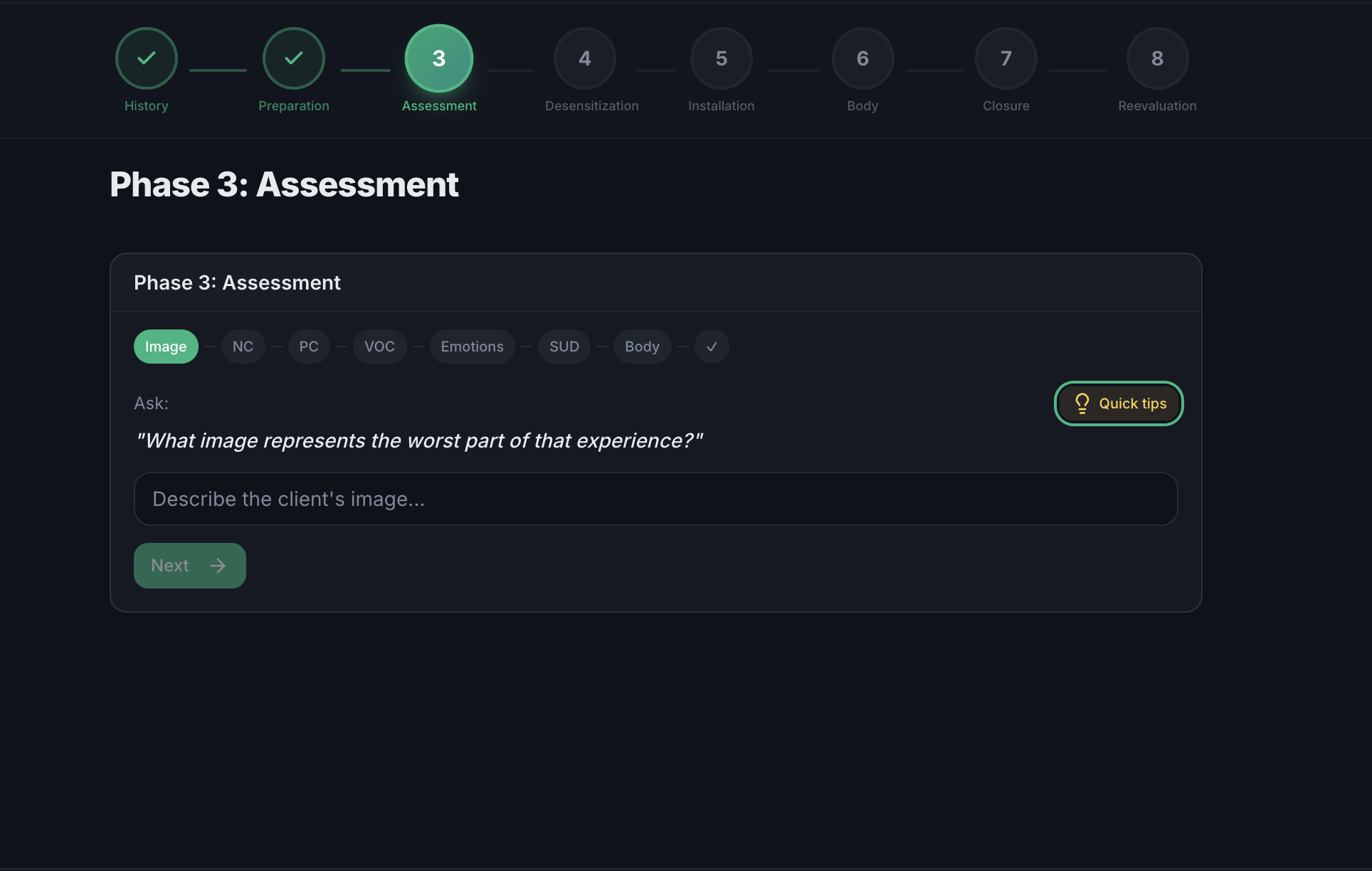
- Phase 3 — Assessment: target image, NC, PC, VOC, emotion, body location, baseline SUD
- Phase 4 — Desensitization: BLS sets, channel work, interweaves until SUD = 0
- Phase 5 — Installation: pair the positive cognition with the target, raise VOC to 7
- Phase 6 — Body Scan: scan for residual body sensation, process anything that surfaces
- Phase 7 — Closure: complete or incomplete close, between-session log, calm place
- Phase 8 — Reevaluation: check prior target, decide next move
| Phase | Purpose | Typical time |
|---|---|---|
| 1. History Taking | Targets, history, dissociation screen | 1–3 sessions |
| 2. Preparation | Psychoeducation, resourcing, BLS test | 1–4+ sessions |
| 3. Assessment | Image, NC, PC, VOC, emotion, body, SUD | 10–15 min |
| 4. Desensitization | BLS sets until SUD = 0 | 30–60 min |
| 5. Installation | PC installed to VOC 7 | 5–10 min |
| 6. Body Scan | Clear residual somatic activation | 5–10 min |
| 7. Closure | Complete or incomplete close | 5–10 min |
| 8. Reevaluation | Recheck target, choose next move | Start of next session |
Want it on paper? The free EMDR protocol PDF has all 8 phases with verbatim scripts on a single printable document.
Where the protocol most often breaks down
In our consultation data, three protocol breakdowns come up over and over:
- Skipping or rushing Phase 2. Therapists move into reprocessing before the client has a reliable calm place and container. When phase 4 gets activated, there's nowhere safe to land.
- Phase 3 assessment without a body location. Body location is what tells you the memory is encoded somatically and what you'll later track in phase 6. Skipping it makes phase 6 vague.
- Calling phase 4 "done" at SUD 1-2. The standard protocol asks for SUD = 0 before installation. SUD 1-2 often signals a remaining channel — investigate before installing. If sets keep stalling, some clinicians layer a working-memory task on top of BLS (see EMDR 2.0) to push through the plateau.
Protocol resources
The standard protocol is the foundation. Once you're comfortable with it, branch into:
- EMDR 2.0 — de Jongh & Matthijssen's working-memory-taxing evolution of the standard protocol (modifies Phase 4)
- Recent Events Protocol — for events within the last 2-3 months that haven't yet consolidated
- Attachment-Focused EMDR — Parnell's modifications for early relational trauma
- EMDR with Children — developmentally adapted protocol
- EMDR & Dissociation — when phased stabilization needs to come first
Free printable protocol tools
All resources- EMDR Script PDF — Free 8-Phase Protocol Script for CliniciansA free EMDR script PDF for clinicians: the standard 8-phase protocol on one desk reference — suggested therapist wording, procedural cues and stall-recovery prompts on a single PDF you can keep on your desk.
- EMDR Phase 1 History-Taking WorksheetA clinician-built printable for the first 1–3 EMDR sessions — intake, readiness screening, and the three-pronged target sequence plan on a single worksheet.
- EMDR Target Sequence Plan TemplateA printable three-pronged Target Sequence Plan worksheet — organise past targets, present triggers and future templates before reprocessing begins.
- EMDR Resourcing Scripts PDF — Free Phase 2 DownloadA free EMDR resourcing scripts PDF — five Phase 2 scripts on a single sheet: Calm Place, Container, and Resource Development & Installation for Nurturing, Protective and Wise figures.
- EMDR Phase 3 Assessment WorksheetA printable Phase 3 worksheet to capture Image, NC, PC, VoC, Emotion, SUD and body location for a single target — with the standard NC/PC cluster table on the back.
- EMDR Session Processing LogA live clinician log for Phase 4–6 reprocessing — record each BLS set, what came up, the SUD trajectory, interweaves used, Installation, Body Scan and closure.
- EMDR Phase 6 Body Scan & Somatic Tracking WorksheetA printable Phase 6 companion sheet — somatic map, BLS-set tracking, residual-sensation interweaves, and end-of-session closure check on a single sheet per completed target.
- Cognitive Interweaves EMDR PDF — Free Cheat Sheet DownloadFree cognitive interweaves EMDR PDF — a clinician quick-reference for unblocking stalled Phase 4 processing, with example interweaves across responsibility, safety, choice, education, imagination and somatic prompts.
- EMDR Progress Note TemplateAn EMDR progress note template — structured around the 8-phase model with medical-necessity language, measures, risk screening and plan.
References
- Shapiro, F. (2018). Eye Movement Desensitization and Reprocessing (EMDR) Therapy: Basic Principles, Protocols, and Procedures (3rd ed.). Guilford Press.
- EMDR International Association (EMDRIA). About EMDR Therapy. Accessed 2026.
- World Health Organization (2013). Guidelines for the Management of Conditions Specifically Related to Stress. Geneva: WHO.
- American Psychological Association (2017). Clinical Practice Guideline for the Treatment of PTSD in Adults.
Frequently asked questions
What is the first step in the EMDR protocol?
The first step is Phase 1: History Taking. In this phase the clinician gathers relevant trauma history, screens for dissociation (typically with the DES-II), identifies targets for reprocessing, and builds a target sequence plan before any bilateral stimulation is introduced.
How many phases are in EMDR?
There are eight phases in the standard EMDR protocol: History Taking, Preparation, Assessment, Desensitization, Installation, Body Scan, Closure, and Reevaluation.
What are the 8 phases of EMDR in order?
In order: (1) History Taking, (2) Preparation, (3) Assessment, (4) Desensitization, (5) Installation, (6) Body Scan, (7) Closure, (8) Reevaluation. Phases 1–2 usually span several sessions; phases 3–6 typically run inside a single reprocessing session; phase 8 opens the following session.
How long does each EMDR phase take?
History taking commonly runs 1–3 sessions and preparation 1–4 or more depending on stability. Within a reprocessing session, assessment takes about 10–15 minutes, desensitization 30–60, and installation, body scan, and closure roughly 5–10 minutes each.
Is there a free PDF of the 8 EMDR phases?
Yes — the free EMDR protocol script PDF covers all eight phases with verbatim clinician wording, BLS cues, and Phase 4 stall-recovery prompts on a single printable document.
What is the standard EMDR protocol?
The standard EMDR protocol is Francine Shapiro's eight-phase model. It is the foundation EMDRIA basic training is built around and the reference point every EMDR variation adapts from.
Can EMDR phases be done in the same session?
Yes — phases 3–6 typically happen in one reprocessing session when the channel completes. Phases 1–2 usually span multiple sessions before reprocessing begins.
What is Phase 3 of EMDR?
Phase 3 (Assessment) is where you capture the target image, negative cognition, positive cognition, VOC, emotion, body location, and baseline SUD — before any BLS begins.
What is the closure phase of EMDR?
Phase 7 (Closure) ends every session, whether reprocessing is complete or not. For incomplete sessions, you debrief, use a calm place or container exercise, and remind the client to log between-session material.
When should I deviate from the standard EMDR protocol?
Deviate when clinically indicated — complex trauma, dissociation, or attachment work often need adapted protocols. Always document your reasoning in your consultation log.
Is EMDR an exposure therapy?
EMDR includes brief, titrated attention to the target memory during bilateral stimulation, but it is not classical prolonged exposure. The Adaptive Information Processing (AIP) model frames EMDR as a memory-reconsolidation intervention, not a habituation-based exposure protocol.
Related tools for EMDR therapists
Try EMDR Assist with your next session
14-day free trial. No credit card. Built by clinicians, for clinicians.