

EMDR Assist is not affiliated with or endorsed by the developers of EMDR 2.0 (Ad de Jongh, Suzy Matthijssen and colleagues). This page summarises published research in our own words. Learn the protocol through the developers' training.
What counts as an EMDR 2.0 tool?
An EMDR 2.0 tool is any task that measurably increases working-memory load during Phase 4 desensitization. The working-memory theory of EMDR (Andrade, Kavanagh & Baddeley, 1997; van den Hout & Engelhard, 2012) predicts that the more the client's limited-capacity working memory is taxed while they hold the target memory in mind, the greater the per-minute reduction in vividness and emotionality. EMDR 2.0 (de Jongh & Matthijssen) operationalises this by layering additional tasks on top of standard bilateral stimulation.
For the full theory and evidence base, see the EMDR 2.0 overview.
Reviewed by the EMDR Assist Clinical Team, EMDR-trained clinicians.
Educational reference material for EMDR-trained clinicians. It does not replace EMDRIA-approved Basic Training, consultation, supervision, or clinical judgement, and it is not medical advice.
The core EMDR 2.0 toolkit
- Fast, variable bilateral stimulation. Increase BLS speed beyond the standard rate, and switch direction (horizontal, diagonal, figure-eight) or modality (visual, auditory, tactile) within a set to prevent habituation.
- Backward counting. Ask the client to count aloud backward from 100 in steps of 7 while holding the target image and following BLS.
- Mental arithmetic. Random two-digit addition or multiplication problems delivered every few seconds during BLS.
- Dual visual + auditory task. Client tracks moving BLS visually while also naming spoken words, animals, or colours in categories.
- Working-memory games. Short digit-span or n-back style prompts (e.g. 'repeat these digits backwards') interleaved with BLS.
- Motor tapping patterns. Client taps a non-standard rhythm (left-right-left-left) with the hands while holding the image.
- Self-paced BLS control. Client controls BLS speed with a button or slider, forcing continual decisions and raising load.
How to titrate load — the therapeutic window
The rule of thumb is simple: load the client to the point where they can just barely keep the target memory in mind. Too little load and you waste the mechanism; too much and the memory collapses out of awareness and reprocessing stalls.
- Start standard. One or two sets of ordinary BLS to confirm the client can access the target.
- Add one modifier. Faster BLS, then backward counting on top — not both at once.
- Check between sets. Ask "were you still seeing the image?" If no, drop load. If yes with high effort, hold that level.
- Watch for dissociation. Blank stares, delayed responses, or "I don't know" answers mean back off and stabilise, not push harder.
- Document what worked. The task/level that produced the biggest SUD drop is worth reusing next session.
Tools you can use right now
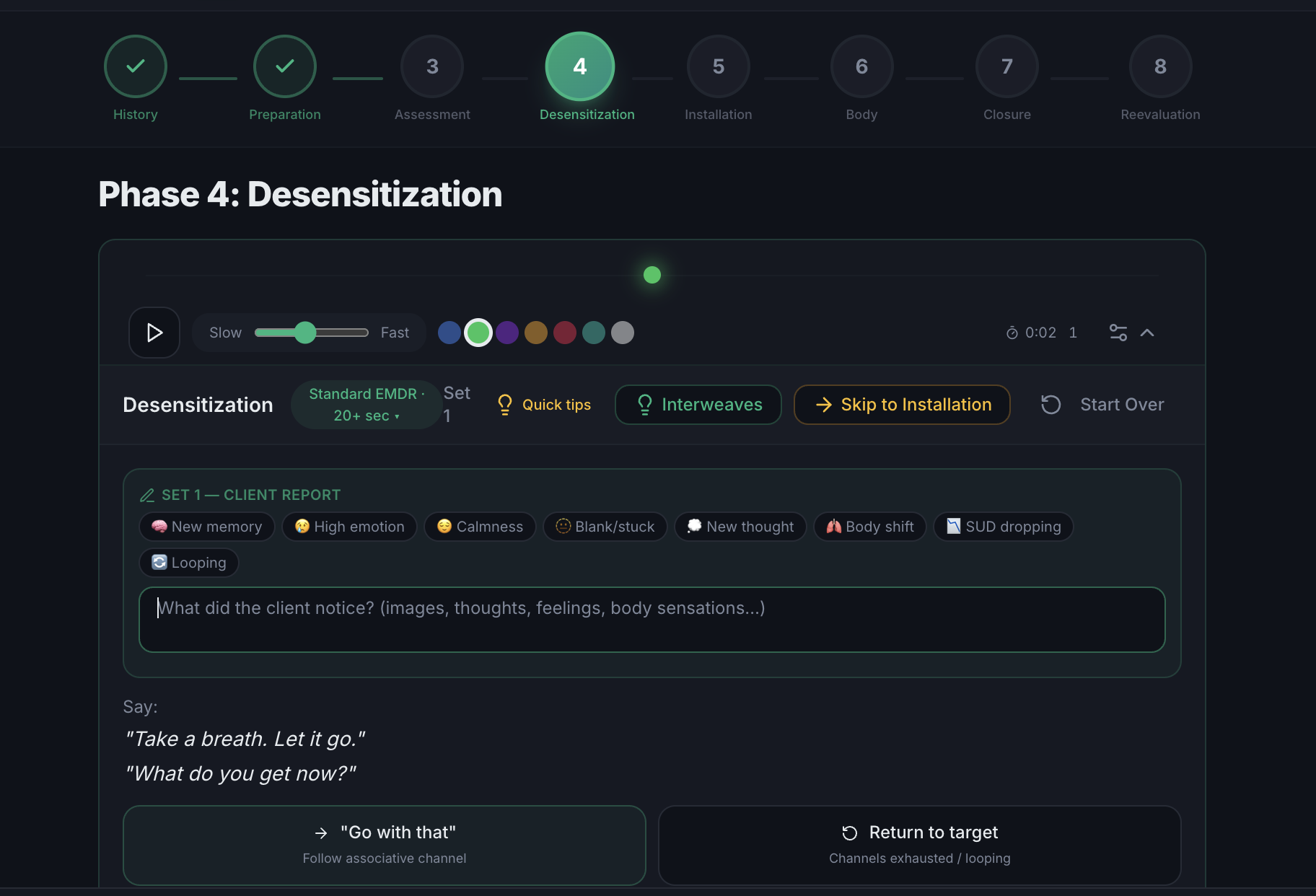
- Free BLS tool — browser-based bilateral stimulation with variable speed, direction, colour, and audio; supports the EMDR 2.0 style of fast, varied BLS.
- Standalone BLS for tele-EMDR — a client-facing view you can share on screen.
- Bilateral stimulation music — pans audio left-right for the auditory modality in dual-task pairings.
- EMDR 2.0 science brief (PDF) — two-page referenced summary you can share with supervisees or consult groups.
Printable Phase 4 tools
All resources- EMDR Session Processing LogA live clinician log for Phase 4–6 reprocessing — record each BLS set, what came up, the SUD trajectory, interweaves used, Installation, Body Scan and closure.
- EMDR Phase 3 Assessment WorksheetA printable Phase 3 worksheet to capture Image, NC, PC, VoC, Emotion, SUD and body location for a single target — with the standard NC/PC cluster table on the back.
- Cognitive Interweaves EMDR PDF — Free Cheat Sheet DownloadFree cognitive interweaves EMDR PDF — a clinician quick-reference for unblocking stalled Phase 4 processing, with example interweaves across responsibility, safety, choice, education, imagination and somatic prompts.
- EMDR Phase 6 Body Scan & Somatic Tracking WorksheetA printable Phase 6 companion sheet — somatic map, BLS-set tracking, residual-sensation interweaves, and end-of-session closure check on a single sheet per completed target.
- EMDR Resourcing Scripts PDF — Free Phase 2 DownloadA free EMDR resourcing scripts PDF — five Phase 2 scripts on a single sheet: Calm Place, Container, and Resource Development & Installation for Nurturing, Protective and Wise figures.
- EMDR Script PDF — Free 8-Phase Protocol Script for CliniciansA free EMDR script PDF for clinicians: the standard 8-phase protocol on one desk reference — suggested therapist wording, procedural cues and stall-recovery prompts on a single PDF you can keep on your desk.
When not to use EMDR 2.0 tools
- Insufficient Phase 2. If the client does not yet have a reliable calm place, container, and demonstrated affect regulation, added cognitive load can push them out of the window of tolerance rather than through reprocessing.
- Active dissociation. Screen with the DES-II. Structural dissociation and high dissociative scores call for a phased approach; higher load is the wrong lever.
- Neurocognitive limitations. Some working-memory tasks (backward arithmetic, n-back) presume intact processing speed and numeracy — pick a modality that matches the client.
- Trial-and-error without a plan. Add one tool at a time and note the effect; layering three modifications simultaneously makes the source of any change impossible to identify.
References
- Andrade, J., Kavanagh, D., & Baddeley, A. (1997). Eye-movements and visual imagery: A working memory approach to the treatment of post-traumatic stress disorder. British Journal of Clinical Psychology, 36(2), 209–223.
- Matthijssen, S. J. M. A., & Menses, S. D. F. (2024). Case report: Intensive online trauma treatment combining prolonged exposure and EMDR 2.0 in a patient with severe and chronic PTSD. Frontiers in Psychiatry, 15, 1370358.
- Matthijssen, S. J. M. A., Brouwers, T., van Roozendaal, C., Vuister, T., & de Jongh, A. (2021). The effect of EMDR versus EMDR 2.0 on emotionality and vividness of aversive memories in a non-clinical sample. European Journal of Psychotraumatology, 12(1), 1956793.
- Mertens, G., Lund, M., & Engelhard, I. M. (2021). The effectiveness of dual-task interventions for modulating emotional memories in the laboratory: A meta-analysis. Acta Psychologica, 220, 103424.
- van den Hout, M. A., & Engelhard, I. M. (2012). How does EMDR work? Journal of Experimental Psychopathology, 3(5), 724–738.
Frequently asked questions
What tools are used in EMDR 2.0?
EMDR 2.0 uses working-memory-taxing tools layered onto bilateral stimulation: fast and varied BLS (direction, speed, and modality changes), backward counting, mental arithmetic, dual visual + auditory tasks, digit-span or n-back working-memory games, non-standard motor tapping patterns, and self-paced BLS control.
What is the best BLS tool for EMDR 2.0?
Any BLS tool that supports variable speed, direction changes within a set, and multiple modalities (visual, auditory, tactile) fits EMDR 2.0 well. Our free browser tool at /bls-tool is built for this style; whatever tool you use, avoid ones locked to a single steady speed.
Is EMDR 2.0 done with software or in person?
Both. In-person clinicians use handheld pulsers, light bars, or on-screen BLS; teletherapy clinicians share a browser BLS tool. What matters for EMDR 2.0 is the ability to vary speed, direction, and modality, and to layer additional cognitive tasks on top.
How do I add working memory tasks to EMDR sessions?
Start with standard BLS to confirm the target is accessible, then add one modifier (e.g. backward counting in 7s). Check between sets whether the client can still see the image. If yes with visible effort, hold that level; if no, reduce load. Do not stack multiple modifiers in the first set.
Can I use EMDR 2.0 tools online with telehealth clients?
Yes. Screen-shared BLS plus verbal prompts (arithmetic, counting) works well on video. Test the client's audio delay and video framerate first — high latency degrades BLS timing.
Do I need special training to use EMDR 2.0 tools?
You need basic EMDR training first; EMDR 2.0 is a post-basic modification. Formal EMDR 2.0 training is offered by de Jongh, Matthijssen, and colleagues and by several EMDR Europe-affiliated providers.
Are EMDR 2.0 tools safe for dissociative clients?
Not by default. Higher cognitive load can destabilise dissociative or under-resourced clients. Screen with the DES-II, complete Phase 2 stabilisation, and if you do progress, add load in small increments rather than jumping to fast BLS plus arithmetic.
Related tools for EMDR therapists
Try EMDR Assist with your next session
14-day free trial. No credit card. Built by clinicians, for clinicians.