

EMDR Assist is not affiliated with or endorsed by the developers of EMDR 2.0 (Ad de Jongh, Suzy Matthijssen and colleagues). This page summarises published research in our own words. Learn the protocol through the developers' training.
What 'activate the memory' means in EMDR 2.0
In standard EMDR, target activation means bringing up the image, the negative cognition, the emotion, and the body sensation so the memory network is live and available for reprocessing. EMDR 2.0 keeps that same requirement but adds two moves: activation is shorter (fewer questions, tighter language) and it is followed immediately by higher working-memory load than standard EMDR would use.
The working-memory theory (Andrade, Kavanagh & Baddeley, 1997; van den Hout & Engelhard, 2012) predicts that reprocessing depends on taxing working memory while the target is held in mind. If the memory is not activated first, taxing does nothing. If activation is prolonged without load, the client rehearses distress rather than reprocesses it. Both matter.
Reviewed by the EMDR Assist Clinical Team, EMDR-trained clinicians.
Educational reference material for EMDR-trained clinicians. It does not replace EMDRIA-approved Basic Training, consultation, supervision, or clinical judgement, and it is not medical advice.
The 10-step activation sequence
- Confirm Phase 2 readiness. Before activating any traumatic material, confirm calm place, container, and affect-regulation skills. Skipping this makes higher working-memory load unsafe.
- Elicit the target succinctly. Ask: 'When you think about the incident now, what image represents the worst part?' Keep it to a single image — activation, not narration.
- Anchor the negative cognition and emotion. Elicit the NC ('I am powerless'), current emotion, and body location. In EMDR 2.0 these are gathered quickly — no extended assessment ritual.
- Take baseline SUD and VoC. SUD 0–10 for current distress; VoC 1–7 for the preferred positive cognition. Write both down — you will re-measure often.
- Hold the image + NC + body sensation together for 5–10 seconds. This is the activation moment. Ask the client to bring up all three at once and nod when it is 'live.' Do not start BLS until they signal activation.
- Start high-load BLS immediately. Begin faster-than-standard BLS the moment activation is confirmed. Delay lets the memory decay before working-memory taxation can occur.
- Layer one working-memory task. Add backward counting in 7s, category naming, or a motor tapping pattern. One task, not three.
- Between-set check. 'What did you notice?' If the client is blank or dissociated, drop load. If the image is still present with effort, hold the level and continue.
- Re-activate if the image fades. If the image is gone and SUD is not near 0, re-elicit the image briefly ('bring the picture back'), then resume BLS with load.
- Track SUD every 2–3 sets. Continuous monitoring is what tells you the memory is desensitizing versus avoiding. Note SUD trajectory in the session log.
Clinician language you can use
- Activation: "Bring up the image, the words '{NC}', and where you feel it in your body. Nod when you have all three."
- Starting BLS + load: "Keep the picture there while your eyes follow the dot. As you do, count backwards from 100 in 7s out loud. Ready?"
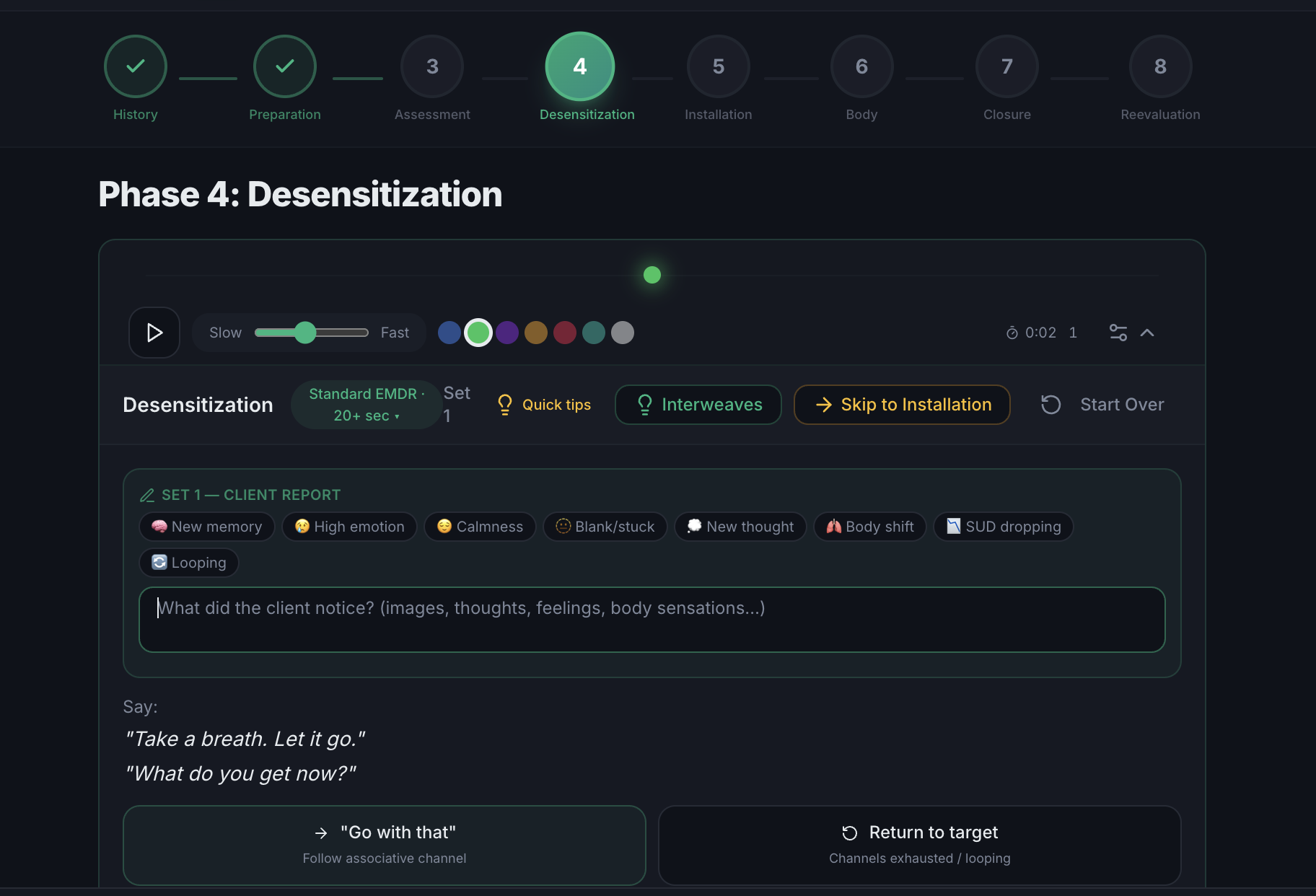
- Between sets: "Take a breath. What did you get?" — then either "Go with that" or, if faded, "Bring the picture back and let's do another set."
- Re-activation: "Notice the original image again — just the worst part — and hold it while the dot moves."
Troubleshooting activation
- Client can't 'see' anything. Use the felt sense — "Where do you feel it? Stay with that." A body anchor is a valid activation target when imagery is absent (alexithymia, pre-verbal material). See the Affect Bridge for eliciting these targets.
- Image collapses within one set. Load is too high or the client is dissociating. Drop the added task; do plain BLS for one set; re-check.
- Client narrates instead of activating. Interrupt gently: "We can talk about the story later. Right now, just the picture and the feeling."
- No emotional signal. Check that you have the actual worst moment, not a summary. Use the floatback to find the earlier node if the current target feels flat.
- Over-activation / abreaction. Stay present; use the "train" metaphor; shorten sets; return to calm place if outside window of tolerance.
Where this fits in the protocol
Activation sits between Phase 3 (Assessment) and Phase 4 (Desensitization) in the standard 8-phase model. In EMDR 2.0 the boundary is blurred: the last minute of assessment flows directly into the first BLS set with load. See the full EMDR 2.0 overview and the tools toolkit for the working-memory tasks referenced above.
Related printable resources
All resources- EMDR Phase 3 Assessment WorksheetA printable Phase 3 worksheet to capture Image, NC, PC, VoC, Emotion, SUD and body location for a single target — with the standard NC/PC cluster table on the back.
- EMDR Session Processing LogA live clinician log for Phase 4–6 reprocessing — record each BLS set, what came up, the SUD trajectory, interweaves used, Installation, Body Scan and closure.
- Cognitive Interweaves EMDR PDF — Free Cheat Sheet DownloadFree cognitive interweaves EMDR PDF — a clinician quick-reference for unblocking stalled Phase 4 processing, with example interweaves across responsibility, safety, choice, education, imagination and somatic prompts.
- EMDR Resourcing Scripts PDF — Free Phase 2 DownloadA free EMDR resourcing scripts PDF — five Phase 2 scripts on a single sheet: Calm Place, Container, and Resource Development & Installation for Nurturing, Protective and Wise figures.
- EMDR Script PDF — Free 8-Phase Protocol Script for CliniciansA free EMDR script PDF for clinicians: the standard 8-phase protocol on one desk reference — suggested therapist wording, procedural cues and stall-recovery prompts on a single PDF you can keep on your desk.
- EMDR Phase 6 Body Scan & Somatic Tracking WorksheetA printable Phase 6 companion sheet — somatic map, BLS-set tracking, residual-sensation interweaves, and end-of-session closure check on a single sheet per completed target.
Frequently asked questions
How do you activate a memory in EMDR 2.0?
Bring up the target image, the negative cognition, and the body sensation together for 5–10 seconds. Confirm activation with a nod, then start high-load BLS immediately with one working-memory task (e.g., backward counting in 7s) layered on top.
How is EMDR 2.0 activation different from standard EMDR?
The elements are the same (image, NC, emotion, body), but activation is briefer, transitions immediately into BLS, and is paired with higher working-memory load than standard Phase 4.
What if the client can't visualize the target?
Use the body sensation as the activation anchor and try the Affect Bridge to elicit a felt-sense target. Imagery is helpful but not required for reprocessing.
How long should activation take?
5–15 seconds. Longer than that risks rehearsal of distress without the taxation mechanism engaging.
What if the memory fades mid-set?
Between sets, ask the client to 'bring the picture back' briefly, then resume BLS with load. If it fades every set, drop the added working-memory task and use plain BLS for a set before re-adding load.
Can I activate memory in EMDR 2.0 over telehealth?
Yes. Screen-share a BLS tool with variable speed and use verbal prompts (counting, category naming) for the working-memory task. Test audio latency first — high delay degrades the taxation effect.
Is target activation safe with dissociative clients?
Only after thorough Phase 2 stabilization, DES-II screening, and titration of load. If dissociation appears during activation, stop, re-orient, and return to stabilization before proceeding.
Related tools for EMDR therapists
Try EMDR Assist with your next session
14-day free trial. No credit card. Built by clinicians, for clinicians.