

EMDR Assist is not affiliated with or endorsed by the developers of EMDR 2.0 (Ad de Jongh, Suzy Matthijssen and colleagues). This page summarises published research in our own words. Learn the protocol through the developers' training.
What is EMDR 2.0?
EMDR 2.0 is a procedural refinement of Shapiro's standard 8-phase EMDR protocol developed by Suzy Matthijssen and Ad de Jongh at Utrecht/PSYTREC in the Netherlands. It applies the working-memory theory of EMDR (Andrade, Kavanagh & Baddeley, 1997; van den Hout & Engelhard, 2012) more aggressively — using faster, more varied bilateral stimulation and additional cognitive tasks layered on top of BLS to maximally tax working memory during Phase 4 desensitization.
For the full explainer, see the EMDR 2.0 overview. This page focuses on the research base.
Reviewed by the EMDR Assist Clinical Team, EMDR-trained clinicians.
Educational reference material for EMDR-trained clinicians. It does not replace EMDRIA-approved Basic Training, consultation, supervision, or clinical judgement, and it is not medical advice.
The theoretical foundation
EMDR 2.0 is built on the working-memory taxation hypothesis. Working memory has limited capacity; when a client holds a traumatic image in mind and performs a demanding secondary task, both compete for the same limited resource. The image is stored less vividly and with less emotional charge on re-encoding.
- Andrade, Kavanagh & Baddeley (1997). The original proposal that EMDR's eye movements reduce vividness and emotionality of traumatic imagery by taxing the visuospatial sketchpad.
- van den Hout & Engelhard (2012). A synthesis of over a decade of experimental work supporting working memory as EMDR's core mechanism — and predicting that more load produces more effect, provided the target memory stays in awareness.
- Engelhard, van den Hout, Dek et al. (2011). Taxing working memory also reduced the vividness and emotional intensity of feared future images ("flashforwards"), not only memories of the past.
Working-memory theory predicts that a more taxing task should have a larger effect. EMDR 2.0 is built on that prediction, although lab evidence that heavier tasks add benefit is mixed (Mertens et al., 2019).
Key EMDR 2.0 studies
- Matthijssen, Brouwers, van Roozendaal, Vuister & de Jongh (2021), European Journal of Psychotraumatology, 12(1), 1956793. The first randomized comparison of EMDR 2.0 and standard EMDR, in 62 non-clinical adults with a disturbing memory. Both reduced emotionality and vividness equally, with no difference in session time; the EMDR 2.0 group needed fewer sets.
- Matthijssen & Menses (2024), Frontiers in Psychiatry, 15, 1370358. Single-patient case report of an intensive online programme combining prolonged exposure and EMDR 2.0 for severe, chronic PTSD; the patient reached remission. A proof of concept, not evidence of effectiveness.
- Uncontrolled clinical studies. The developers list further uncontrolled studies of intensive programmes that include EMDR 2.0 (with veterans, adolescents and adults with PTSD). Because EMDR 2.0 is combined with other treatments in these programmes, they cannot isolate its effect.
- Mertens, Lund & Engelhard (2021), Acta Psychologica, 220, 103424. Meta-analysis of 53 laboratory studies: dual tasks during recall made negative and positive memories less vivid and less emotional, supporting the working-memory mechanism EMDR 2.0 relies on.
- In progress: the ENHANCE trial (Alting van Geusau et al., 2023, study protocol in Frontiers in Psychiatry, 14, 1278052). A randomized trial of 130 patients with PTSD comparing six sessions of EMDR, EMDR 2.0 and the Flash technique, the first RCT of EMDR 2.0 in a diagnosed PTSD sample.
What the evidence supports — and doesn't
Supported:
- Dual tasks during recall reduce the vividness and emotionality of memories in the lab (meta-analysis of 53 studies).
- In one lab study, EMDR 2.0 matched standard EMDR's effect on a disturbing memory with fewer sets.
- Clinicians have used EMDR 2.0 within intensive PTSD programmes, described in case reports and uncontrolled studies.
Not yet demonstrated:
- Any advantage of EMDR 2.0 over standard EMDR on PTSD symptoms in a randomized trial (ENHANCE is under way).
- That heavier dual tasks reliably add benefit (lab results are mixed).
- Effectiveness with high-dissociation or complex-trauma samples specifically.
- Safety and effectiveness with children or adolescents.
- EMDRIA (US) endorsement — EMDR 2.0 is not currently EMDRIA-approved; it is a modification of the Shapiro protocol.
How to read the evidence responsibly
- Most published EMDR 2.0 studies use analogue paradigms (aversive film clips or autobiographical negative memories in non-clinical samples). These support the mechanism but do not by themselves establish clinical superiority.
- The clinical studies so far have no comparison group and combine EMDR 2.0 with other treatments, so they cannot isolate the EMDR 2.0 modifications.
- Effect sizes for dual-task manipulations in the lab are typically medium; predicting downstream clinical effect from lab effect requires caution.
- Basic EMDR training is a prerequisite for using EMDR 2.0. Phase 2 stabilisation and dissociation screening remain non-negotiable.
Free tools & downloads
- EMDR 2.0 science brief (PDF, 4 pages) — referenced summary of theory, evidence, and clinical implications.
- EMDR 2.0 titration worksheet (PDF, 2 pages) — set-by-set log with dual-task menu.
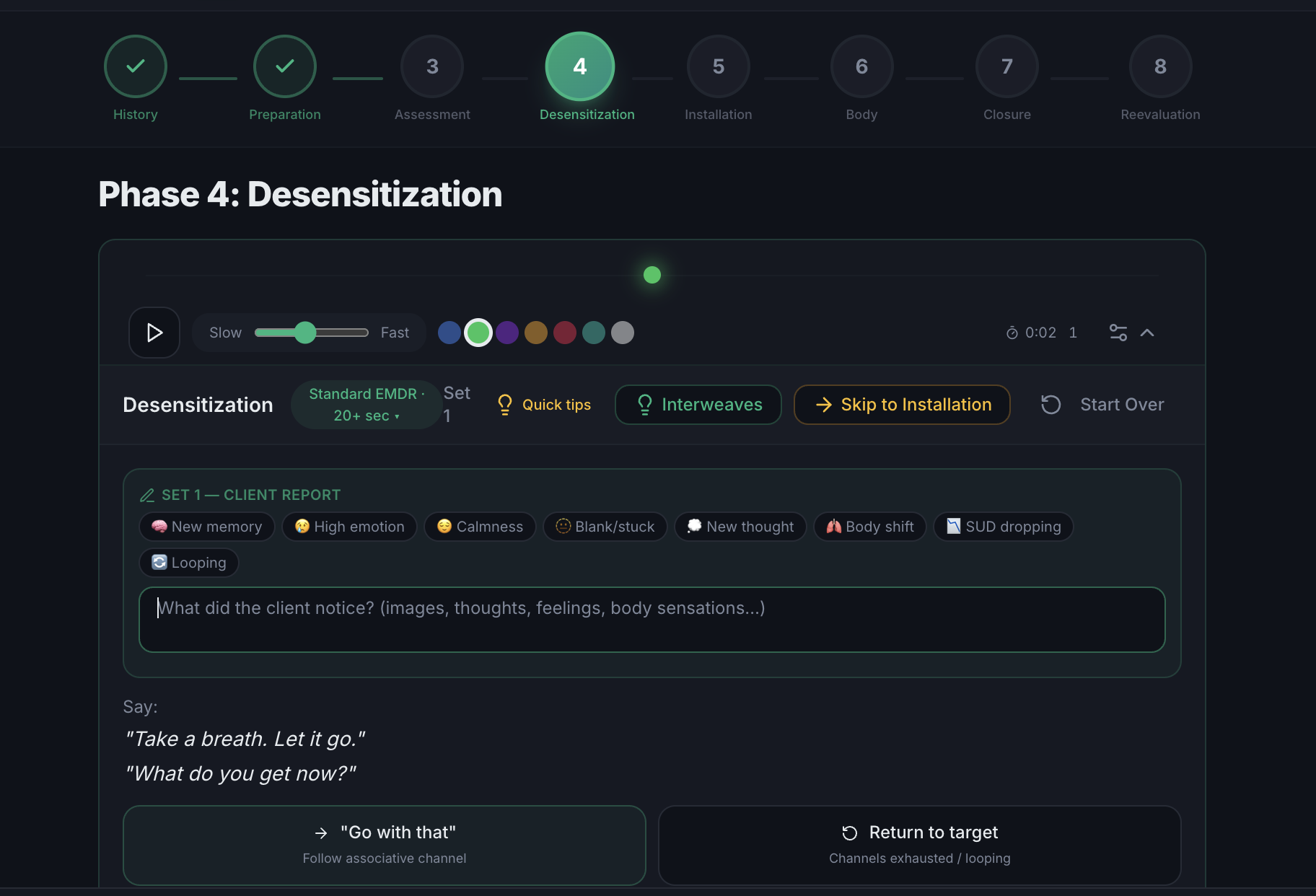
- Free browser BLS tool — variable-speed BLS for the EMDR 2.0 style.
Related evidence-based resources
All resources- EMDR Session Processing LogA live clinician log for Phase 4–6 reprocessing — record each BLS set, what came up, the SUD trajectory, interweaves used, Installation, Body Scan and closure.
- EMDR Phase 3 Assessment WorksheetA printable Phase 3 worksheet to capture Image, NC, PC, VoC, Emotion, SUD and body location for a single target — with the standard NC/PC cluster table on the back.
- Cognitive Interweaves EMDR PDF — Free Cheat Sheet DownloadFree cognitive interweaves EMDR PDF — a clinician quick-reference for unblocking stalled Phase 4 processing, with example interweaves across responsibility, safety, choice, education, imagination and somatic prompts.
- EMDR Phase 6 Body Scan & Somatic Tracking WorksheetA printable Phase 6 companion sheet — somatic map, BLS-set tracking, residual-sensation interweaves, and end-of-session closure check on a single sheet per completed target.
- EMDR Resourcing Scripts PDF — Free Phase 2 DownloadA free EMDR resourcing scripts PDF — five Phase 2 scripts on a single sheet: Calm Place, Container, and Resource Development & Installation for Nurturing, Protective and Wise figures.
- EMDR Script PDF — Free 8-Phase Protocol Script for CliniciansA free EMDR script PDF for clinicians: the standard 8-phase protocol on one desk reference — suggested therapist wording, procedural cues and stall-recovery prompts on a single PDF you can keep on your desk.
Full reference list
- Andrade, J., Kavanagh, D., & Baddeley, A. (1997). Eye-movements and visual imagery: A working memory approach to the treatment of post-traumatic stress disorder. British Journal of Clinical Psychology, 36(2), 209–223.
- Alting van Geusau, V. V. P., de Jongh, A., Nuijs, M. D., Brouwers, T. C., Moerbeek, M., & Matthijssen, S. J. M. A. (2023). The effectiveness, efficiency, and acceptability of EMDR vs. EMDR 2.0 vs. the Flash technique in the treatment of patients with PTSD: study protocol for the ENHANCE randomized controlled trial. Frontiers in Psychiatry, 14, 1278052.
- Engelhard, I. M., van den Hout, M. A., Dek, E. C. P., et al. (2011). Reducing vividness and emotional intensity of recurrent "flashforwards" by taxing working memory: An analogue study. Journal of Anxiety Disorders, 25(4), 599–603.
- Matthijssen, S. J. M. A., Brouwers, T., van Roozendaal, C., Vuister, T., & de Jongh, A. (2021). The effect of EMDR versus EMDR 2.0 on emotionality and vividness of aversive memories in a non-clinical sample. European Journal of Psychotraumatology, 12(1), 1956793.
- Matthijssen, S. J. M. A., & Menses, S. D. F. (2024). Case report: Intensive online trauma treatment combining prolonged exposure and EMDR 2.0 in a patient with severe and chronic PTSD. Frontiers in Psychiatry, 15, 1370358.
- Mertens, G., Krypotos, A.-M., van Logtestijn, A., Landkroon, E., van Veen, S. C., & Engelhard, I. M. (2019). Changing negative autobiographical memories in the lab: A comparison of three eye-movement tasks. Memory, 27(3), 295–305.
- Mertens, G., Lund, M., & Engelhard, I. M. (2021). The effectiveness of dual-task interventions for modulating emotional memories in the laboratory: A meta-analysis. Acta Psychologica, 220, 103424.
- Shapiro, F. (2001). Eye Movement Desensitization and Reprocessing (EMDR): Basic Principles, Protocols, and Procedures (2nd ed.). Guilford Press.
- van den Hout, M. A., & Engelhard, I. M. (2012). How does EMDR work? Journal of Experimental Psychopathology, 3(5), 724–738.
Frequently asked questions
Is EMDR 2.0 evidence-based?
The evidence is early. One randomized lab study in non-clinical adults (Matthijssen et al., 2021) found EMDR 2.0 as effective as standard EMDR with fewer sets, and a lab meta-analysis supports the working-memory mechanism (Mertens et al., 2021). Clinical reports exist but have no comparison group; the first RCT in patients with PTSD (ENHANCE) is under way.
How many EMDR 2.0 studies have been published?
Only a handful test EMDR 2.0 directly: one randomized lab comparison with standard EMDR (Matthijssen et al., 2021), case reports (e.g., Matthijssen & Menses, 2024) and uncontrolled studies of intensive programmes. The ENHANCE randomized trial in PTSD is in progress. Behind them sits a larger body of working-memory research (Andrade 1997; van den Hout & Engelhard 2012; Mertens et al., 2021).
Who developed EMDR 2.0?
EMDR 2.0 was developed by Suzy Matthijssen and Ad de Jongh in the Netherlands, building on Francine Shapiro's original 8-phase protocol and the working-memory theory of EMDR articulated by van den Hout, Engelhard, and Andrade.
Is EMDR 2.0 more effective than standard EMDR?
Not shown yet. In the one published randomized comparison (62 non-clinical adults), both reduced emotionality and vividness equally and EMDR 2.0 needed fewer sets. A randomized trial in patients with PTSD (ENHANCE) is under way.
Is EMDR 2.0 approved by EMDRIA?
No. EMDR 2.0 is a procedural modification of the Shapiro protocol and is not currently EMDRIA-approved. Clinicians should be transparent with clients that they are using a modification, and should have completed basic EMDR training before doing so.
Where can I find EMDR 2.0 research papers?
Search Google Scholar or PubMed for 'EMDR 2.0', 'Matthijssen EMDR', 'de Jongh EMDR 2.0', and 'working memory EMDR'. Key journals include the European Journal of Psychotraumatology, Frontiers in Psychiatry, Behaviour Research and Therapy, and Acta Psychologica.
Related tools for EMDR therapists
Try EMDR Assist with your next session
14-day free trial. No credit card. Built by clinicians, for clinicians.