

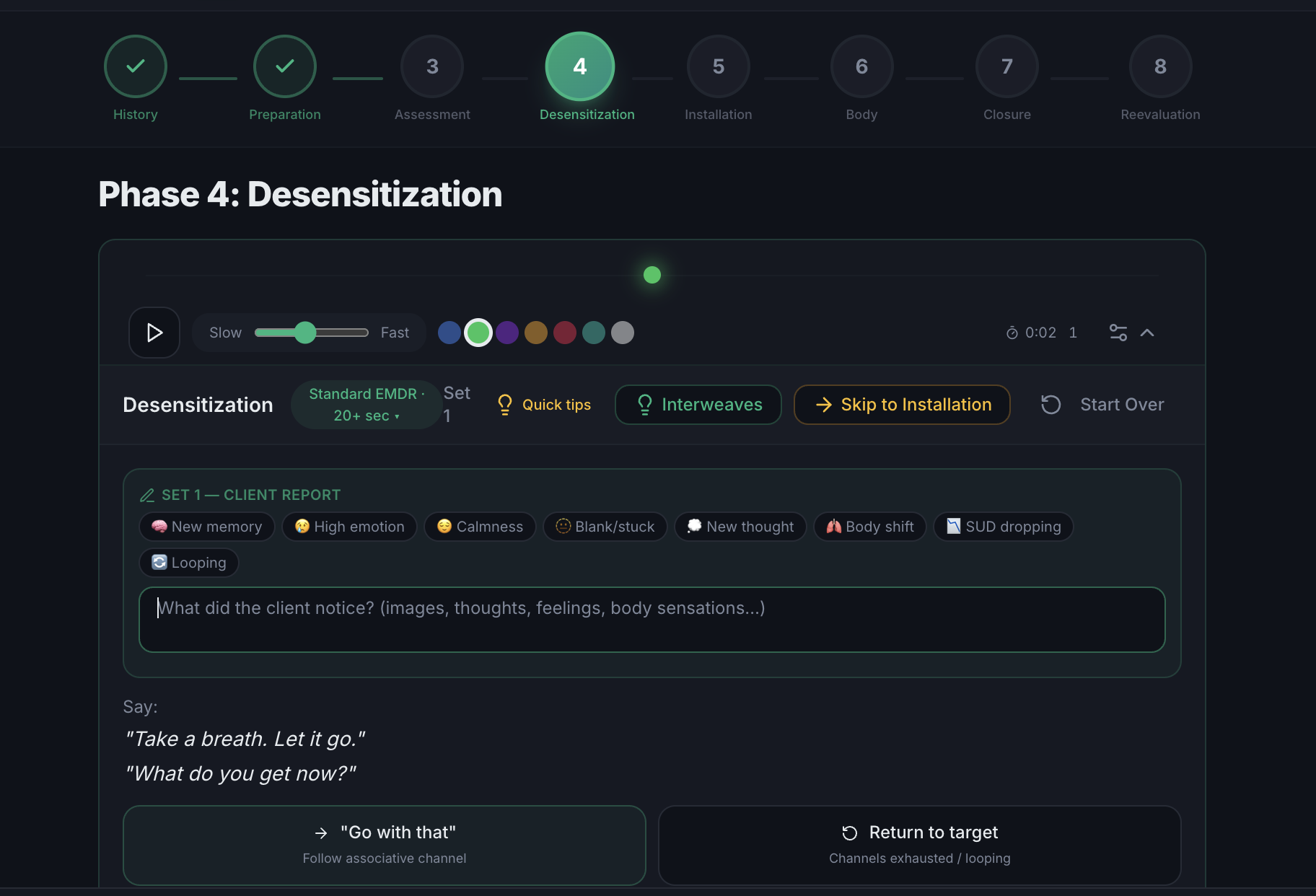
EMDR Assist is not affiliated with or endorsed by the developers of EMDR 2.0 (Ad de Jongh, Suzy Matthijssen and colleagues). This page summarises published research in our own words. Learn the protocol through the developers' training.
The short answer
Standard EMDR is Francine Shapiro's 8-phase protocol, tested in more than 30 randomised controlled trials for PTSD and endorsed as first-line trauma treatment by the WHO, APA, NICE, and the VA/DoD. EMDR 2.0 is a procedural modification of Phase 4 only, developed by Suzy Matthijssen and Ad de Jongh, that increases working-memory load during desensitisation using faster and more varied BLS plus additional cognitive tasks. It shares the other 7 phases with standard EMDR.
EMDR 2.0 is not a replacement for standard EMDR. It is a Phase 4 acceleration for clinicians who have completed basic EMDR training and have stable Phase 2 stabilisation practice.
Reviewed by the EMDR Assist Clinical Team, EMDR-trained clinicians.
Educational reference material for EMDR-trained clinicians. It does not replace EMDRIA-approved Basic Training, consultation, supervision, or clinical judgement, and it is not medical advice.
Full comparison table
| Dimension | Standard EMDR (Shapiro) | EMDR 2.0 (Matthijssen & de Jongh) |
|---|---|---|
| Protocol origin | Francine Shapiro (1987, refined through 2001) | Matthijssen & de Jongh (Netherlands, 2020–2024) |
| Number of phases | 8 (history, prep, assessment, desensitisation, installation, body scan, closure, reevaluation) | Same 8 phases — EMDR 2.0 modifies Phase 4 only |
| Bilateral stimulation speed | Moderate, steady; ~one round-trip per second | Faster; often variable within a set |
| BLS direction / modality changes | Rare within a set | Frequent — direction, modality, and speed all vary |
| Set length | Longer (~24–48 saccades typical) | Shorter, tighter check-in cadence |
| Secondary cognitive tasks | None routine | Layered on: backward counting, arithmetic, dual naming, n-back |
| Working-memory load | Present via BLS alone | Deliberately maximised toward the client's capacity |
| Client role | Passive tracker of BLS | Often active — controls BLS speed, performs secondary tasks |
| Session duration for Phase 4 | Standard 50–90 min slot | Same slot; more targets processed per unit time in analogue studies |
| Evidence base | Nearly 40 years, 30+ RCTs for PTSD, endorsed by WHO, APA, NICE, VA/DoD | Early: one randomized lab study (Matthijssen 2021), case reports and uncontrolled studies; first PTSD RCT (ENHANCE) under way |
| Formal approval | EMDRIA-approved (US), EMDR Europe accredited | Not currently EMDRIA-approved; recognised by EMDR Europe-affiliated bodies |
| Training prerequisite | None (basic EMDR training itself) | Completed basic EMDR training |
| Dissociation risk profile | Manageable with standard Phase 2 stabilisation | Higher load = higher destabilisation risk if Phase 2 is thin |
What actually changes in Phase 4
- BLS speed increases beyond the standard rate, and can vary within a single set rather than staying steady.
- Direction and modality change mid-set — horizontal, diagonal, figure-eight, or visual/auditory/tactile switches — to prevent habituation.
- Sets shorten. Instead of long uninterrupted saccade sequences, EMDR 2.0 uses tighter cycles with more frequent check-ins.
- A secondary cognitive task is added. Backward counting in 7s, mental arithmetic, dual visual+auditory naming, or n-back-style prompts run during BLS.
- The client becomes more active. Sometimes they control BLS speed themselves, forcing continual decisions that raise load naturally.
Phases 1, 2, 3, 5, 6, 7, and 8 are unchanged. History-taking, stabilisation, assessment, installation, body scan, closure, and reevaluation follow standard EMDR.
Which protocol for which client?
Standard EMDR is the default when:
- The client is new to EMDR or has limited Phase 2 stabilisation.
- Dissociation scores are elevated (DES-II, MID) or dissociation is clinically active.
- Working-memory or numeracy limitations make secondary tasks unrealistic.
- You are still building your own basic-EMDR competence.
- The client needs a protocol you can defend under any professional scrutiny (EMDRIA-approved).
EMDR 2.0 modifications are worth considering when:
- Basic EMDR is progressing but per-session gain feels slower than expected.
- Phase 2 stabilisation is solid and the window of tolerance is well-mapped.
- You are working intensively (multi-hour or multi-day formats) and want efficiency per unit time.
- The client has adequate cognitive resources for a secondary task.
- You have completed EMDR 2.0 training or are using well-referenced adaptations under consultation.
Evidence base — honest comparison
Standard EMDR has nearly 40 years of research: PTSD, complex trauma, phobia, depression, chronic pain — more than 30 randomised trials for PTSD, many meta-analyses, and clinical practice guideline endorsements from the WHO, APA Division 12, NICE (UK), and the VA/DoD.
EMDR 2.0 rests on: (a) more than a decade of experimental working-memory research (Andrade, Engelhard, van den Hout), including a meta-analysis of 53 lab studies (Mertens, Lund & Engelhard, 2021); (b) one randomized lab comparison in 62 non-clinical adults, where EMDR 2.0 matched standard EMDR with fewer sets (Matthijssen et al., 2021); and (c) case reports and uncontrolled studies of intensive PTSD programmes. What is not yet published is a randomized trial of EMDR 2.0 vs standard EMDR in PTSD; the ENHANCE trial is under way. See the EMDR 2.0 research page for the full literature.
Downloads and tools
- EMDR 2.0 science brief (PDF) — 4-page referenced summary.
- EMDR 2.0 titration worksheet (PDF) — set-by-set log with dual-task menu.
- Free BLS tool — variable-speed browser BLS for the EMDR 2.0 style.
- Standard 8-phase protocol reference — the base EMDR 2.0 modifies.
Frequently asked questions
What is the main difference between EMDR and EMDR 2.0?
EMDR 2.0 modifies only Phase 4 (desensitisation) of the standard 8-phase EMDR protocol. It uses faster, more variable bilateral stimulation, shorter sets, and adds a secondary cognitive task (e.g. backward counting, mental arithmetic) to maximise working-memory load. Phases 1–3 and 5–8 are unchanged.
Is EMDR 2.0 better than standard EMDR?
Not shown yet. In the one published randomized comparison (62 non-clinical adults), both worked equally well and EMDR 2.0 needed fewer sets. A randomized trial in patients with PTSD (ENHANCE) is under way.
Can I use EMDR 2.0 without basic EMDR training?
No. EMDR 2.0 is a modification of the standard 8-phase protocol and assumes you already have basic EMDR training. All reputable EMDR 2.0 training providers require completed basic training as a prerequisite.
Is EMDR 2.0 safe for complex trauma?
The evidence base for EMDR 2.0 in complex trauma and dissociative disorders is limited. Higher working-memory load can destabilise inadequately prepared clients. For complex trauma, most clinicians should default to standard EMDR with robust Phase 2 stabilisation until further evidence is available.
Does EMDR 2.0 use eye movements?
Yes. Bilateral stimulation is still the core dual-attention task in EMDR 2.0 — eye movements, auditory tones, or tactile taps. What changes is speed, variability, and the layering of a second cognitive task on top.
Is EMDR 2.0 EMDRIA-approved?
No. EMDR 2.0 is currently not on the EMDRIA-approved protocols list. It is recognised by EMDR Europe-affiliated bodies to varying degrees. US clinicians can still use it but should document their approach transparently.
How long does EMDR 2.0 take vs standard EMDR?
A single EMDR 2.0 session runs the same clinical length. The difference is per-session throughput — analogue studies suggest more targets or larger vividness reductions per unit time. Intensive multi-day EMDR 2.0 formats are also common.
Related tools for EMDR therapists
Try EMDR Assist with your next session
14-day free trial. No credit card. Built by clinicians, for clinicians.