

EMDR Assist is not affiliated with or endorsed by the developers of EMDR 2.0 (Ad de Jongh, Suzy Matthijssen and colleagues). This page summarises published research in our own words. Learn the protocol through the developers' training.
What is EMDR 2.0 training?
EMDR 2.0 training is a post-basic workshop that teaches clinicians the procedural modifications developed by Suzy Matthijssen and Ad de Jongh in the Netherlands: faster and more variable bilateral stimulation, shorter sets, and additional working-memory-taxing tasks layered onto Phase 4 desensitization. It is not a replacement for basic EMDR training — it is a modification of the standard 8-phase protocol.
For background on the modification itself, see the EMDR 2.0 overview and the research base.
Reviewed by the EMDR Assist Clinical Team, EMDR-trained clinicians.
Educational reference material for EMDR-trained clinicians. It does not replace EMDRIA-approved Basic Training, consultation, supervision, or clinical judgement, and it is not medical advice.
Prerequisites — before you enrol
- Complete a full basic EMDR training (EMDRIA-approved in the US, EMDR Europe / EMDR UK & Ireland accredited in Europe). EMDR 2.0 assumes you already know Shapiro's 8-phase protocol.
- Have supervised EMDR practice hours. Most providers expect you to have started or completed consultation hours in standard EMDR before adopting a modification.
- Understand the working-memory theory of EMDR. Familiarity with Andrade, Kavanagh & Baddeley (1997) and van den Hout & Engelhard (2012) makes the workshop content land faster.
- Have Phase 2 stabilisation and dissociation screening in your routine. Higher cognitive load amplifies destabilisation risk in inadequately prepared clients.
Who teaches EMDR 2.0?
The primary EMDR 2.0 training pathway runs through Dutch institutions and their affiliated trainers. Because the modification is relatively new and evolving, the training landscape is changing — always confirm current offerings directly with the provider.
- PSYTREC (Bilthoven, Netherlands). The intensive treatment centre co-directed by Ad de Jongh and Suzy Matthijssen, where much of the EMDR 2.0 clinical development took place.
- Utrecht-based trainers and EMDR Europe-affiliated providers. Various clinician-trainers offer EMDR 2.0 workshops in Dutch, English, German, and Spanish.
- National EMDR associations. EMDR Europe, EMDR UK & Ireland, and other national bodies increasingly list EMDR 2.0 workshops in their CPD calendars — check your national association's events page.
- Note on EMDRIA (US). EMDR 2.0 is not currently an EMDRIA-approved protocol. US clinicians can still train in it, but should be aware of the accreditation status when documenting their approach.
Format, duration, and cost
- Typical format. A 1–2 day workshop, in-person or online, combining theory presentation with live demonstration and small-group practice.
- Extended tracks. Some providers offer a multi-day intensive that combines EMDR 2.0 training with observation of intensive PTSD treatment (typical at PSYTREC-linked programmes).
- Cost. Standalone workshops typically fall in the €300–€800 / $350–$900 range depending on provider, length, and format. Intensive multi-day tracks cost more.
- CPD / CE credit. Confirm with your provider — many EMDR Europe-affiliated workshops carry national CPD accreditation; US CE credit is less consistent given the EMDRIA status.
What you'll actually learn
- The working-memory taxation model of EMDR and its empirical basis.
- How to select and titrate secondary cognitive tasks (see the tools page).
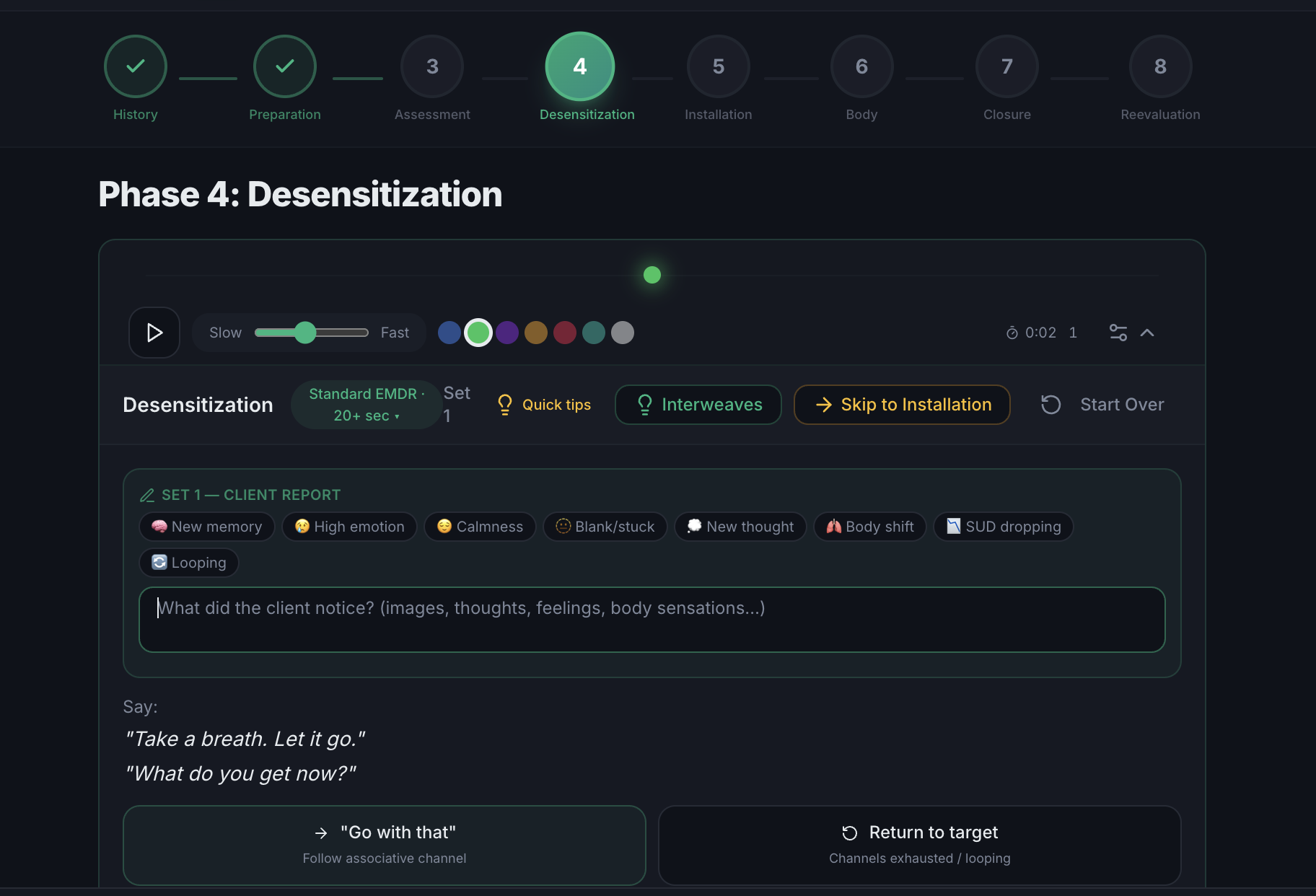
- Modified Phase 4 flow: faster and more varied BLS, shorter sets, tighter between-set check-ins.
- Client selection — when to use EMDR 2.0 modifications and when to stay with standard EMDR.
- Adaptations for group and intensive delivery formats.
- Live demonstration and small-group practice with feedback.
Prepare before your workshop — free resources
- EMDR 2.0 science brief (PDF, 4 pages) — theory + evidence in one document.
- EMDR 2.0 titration worksheet (PDF) — the set-by-set log clinicians typically use post-training.
- EMDR 2.0 tools — the working-memory task menu you'll be trained in.
- Research summary — Matthijssen, de Jongh, Mertens, and the underlying working-memory literature.
- Free BLS tool — practise the variable-speed BLS style before the workshop.
After training — supervision and consult groups
As with basic EMDR, competence in EMDR 2.0 develops through supervised practice, not just workshop attendance. Options after your training:
- Continue consultation with an EMDR consultant who has EMDR 2.0 experience.
- Join or form a peer consult group focused on EMDR 2.0 cases.
- Log sessions with structured notes — the titration worksheet is designed for exactly this.
- Track your hours with the consultation hours tracker if you are working toward EMDRIA or EMDR Europe accreditation.
Frequently asked questions
Do I need basic EMDR training before EMDR 2.0 training?
Yes. EMDR 2.0 is a modification of the standard 8-phase protocol, not a standalone method. All reputable providers require completed basic EMDR training (EMDRIA-approved in the US, EMDR Europe accredited in Europe) as a prerequisite.
Where can I train in EMDR 2.0?
The primary pathway runs through Dutch providers — PSYTREC and Utrecht-affiliated trainers linked to Ad de Jongh and Suzy Matthijssen — plus growing offerings via EMDR Europe-affiliated national associations. Always confirm current CPD dates and format directly with the provider.
How long is EMDR 2.0 training?
Standalone workshops are typically 1–2 days, in-person or online. Some providers offer multi-day intensive tracks that combine EMDR 2.0 training with observation of intensive PTSD treatment.
How much does EMDR 2.0 training cost?
Standalone workshops typically fall in the €300–€800 / $350–$900 range depending on provider, length, and format. Multi-day intensives cost more.
Is EMDR 2.0 training EMDRIA-approved?
No. EMDR 2.0 is not currently an EMDRIA-approved protocol, so training in it does not by itself count toward EMDRIA continuing education requirements. It is recognised by EMDR Europe-affiliated bodies to varying degrees.
Can I learn EMDR 2.0 online?
Some providers deliver EMDR 2.0 workshops via live online video with breakout rooms for practice. Purely self-paced video courses cannot substitute for supervised practice.
What should I read before EMDR 2.0 training?
Andrade, Kavanagh & Baddeley (1997) on working memory and EMDR; van den Hout & Engelhard (2012) on the mechanism; Matthijssen et al. (2021) on the abbreviated protocol. Our free EMDR 2.0 science brief PDF summarises all three.
Related tools for EMDR therapists
Try EMDR Assist with your next session
14-day free trial. No credit card. Built by clinicians, for clinicians.